
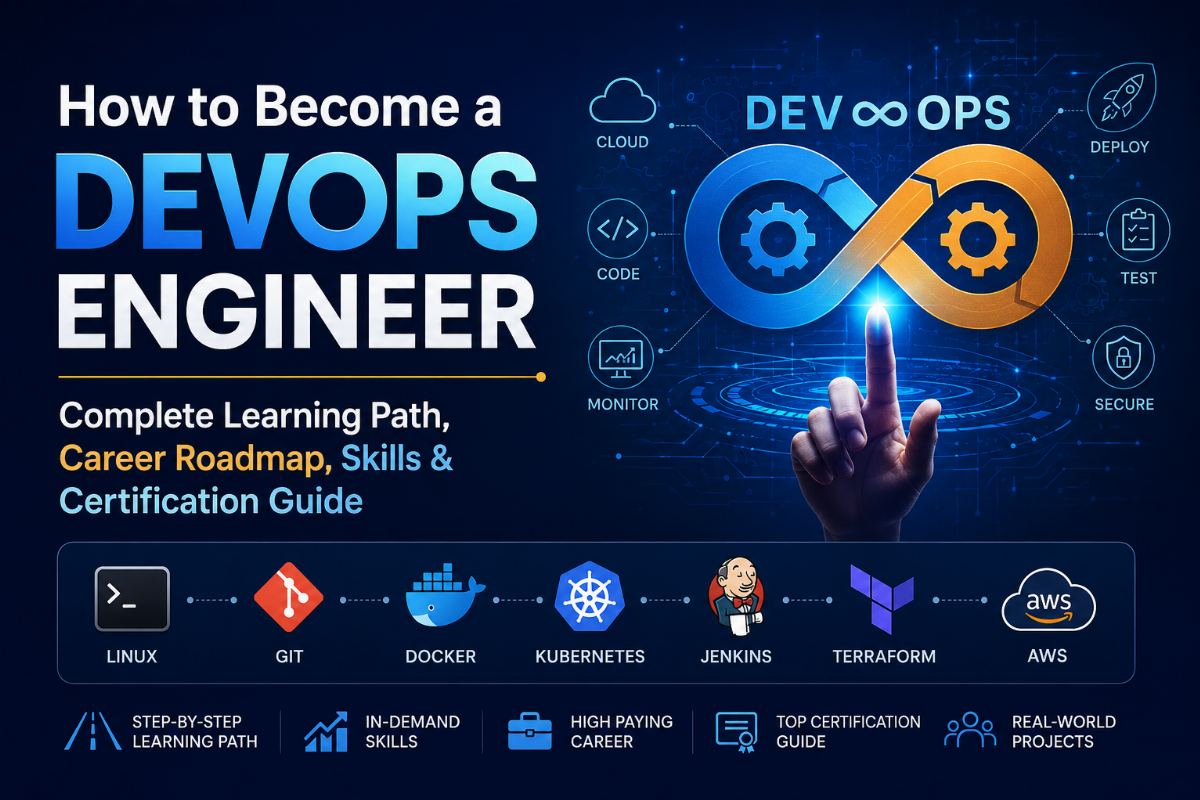
As businesses accelerate digital transformation, the demand for professionals who can streamline software development, automate deployments, and manage scalable cloud infrastructure has grown rapidly. DevOps Engineers play a crucial role in bridging the gap between development and operations teams, enabling organizations to deliver applications faster, improve reliability, and reduce deployment risks.
Whether you're a student, software developer, system administrator, cloud engineer, or IT professional looking to upskill, DevOps offers an exciting career with excellent salary potential and global opportunities. DevOps Engineers are among the most sought-after technology professionals, helping organizations automate software delivery, manage cloud infrastructure, and improve deployment efficiency. Modern DevOps practices combine automation, data & cloud computing, containerization, Infrastructure as Code (IaC), continuous integration, continuous delivery (CI/CD), monitoring, and security to create efficient software delivery pipelines.
In this guide, you'll learn everything you need to know about becoming a DevOps Engineer, including required skills, tools, certifications, career roadmap, interview preparation, and recommended learning paths to help you succeed in one of today's fastest-growing technology careers.
What Does a DevOps Engineer Do?
A DevOps Engineer is responsible for improving collaboration between software development and IT operations teams by automating processes, managing cloud infrastructure, and ensuring applications are delivered quickly, securely, and reliably. Their work spans the entire software development lifecycle—from writing automation scripts and configuring CI/CD pipelines to deploying applications, monitoring system performance, and troubleshooting production issues.
Instead of performing repetitive manual tasks, DevOps Engineers leverage tools like Git, Jenkins, Docker, Kubernetes, Terraform, and cloud platforms such as AWS or Azure to automate software delivery and infrastructure management. They help organizations reduce deployment failures, improve scalability, increase system uptime, and accelerate innovation by implementing modern DevOps practices.
As businesses adopt cloud-native architectures and microservices, DevOps Engineers have become indispensable in building resilient, secure, and highly available systems that support continuous delivery and rapid product development.
[Also Read: How to Become a Data Scientist: Learning Path, Career Roadmap, Certifications, Salary & more]
Why Choose a DevOps Engineer Career?
DevOps has become one of the most rewarding career paths in technology due to the widespread adoption of cloud computing, automation, and agile software development. Organizations are investing heavily in DevOps practices to improve deployment speed, reduce operational costs, and deliver better customer experiences. As a result, skilled DevOps Engineers are in high demand across startups, enterprises, and global technology companies.
A career in DevOps offers excellent salary potential, diverse job opportunities, and continuous learning. The role combines software development, cloud engineering, automation, and infrastructure management, making it ideal for professionals who enjoy solving complex technical challenges. DevOps skills also provide a strong foundation for advancing into roles such as Cloud Engineer, Site Reliability Engineer (SRE), Platform Engineer, DevSecOps Engineer, or Cloud Architect.
Benefits of a DevOps Career
- Strong demand across industries
- High-paying roles in the USA and globally
- Opportunity to work with cutting-edge cloud technologies
- Diverse career progression paths
- Continuous learning and innovation
- High impact on business operations and software quality
Who is a DevOps Engineer?
A DevOps Engineer automates software development, testing, deployment, and infrastructure management using cloud platforms, CI/CD pipelines, containers, and Infrastructure as Code to deliver applications faster and more reliably.
How long does it take to become a DevOps Engineer?
Most beginners can become job-ready in 6–8 months with consistent learning, practical projects, and training in Linux, cloud computing, Docker, Kubernetes, CI/CD, and automation.
What skills are required for a DevOps Engineer?
Essential skills include Linux, Git, Python, Docker, Kubernetes, AWS or Azure, CI/CD, Terraform, Ansible, networking, monitoring, and Infrastructure as Code.
DevOps Engineer Salary in USA
DevOps Engineers are among the highest-paid professionals in IT because they possess expertise across software development, cloud infrastructure, automation, and system reliability. Salaries vary based on experience, certifications, cloud platform expertise, location, and the technologies you work with.
Professionals with skills in Kubernetes, Terraform, AWS, Azure, CI/CD, Infrastructure as Code, and cloud security typically command higher compensation than those with basic system administration experience.
DevOps Engineer Salary by Experience
DevOps Engineer salaries vary by experience, location, certifications, and cloud expertise. Explore typical salary ranges across the USA.
|
Experience |
Estimated Annual Salary (USD) |
|
Entry Level (0–2 Years) |
$95,000–$120,000 |
|
Mid-Level (3–5 Years) |
$120,000–$150,000 |
|
Senior (5–8 Years) |
$150,000–$185,000 |
|
Lead / Principal (8+ Years) |
$185,000–$240,000+ |
High Paying States:
Given below are the US states offering best pay...
- California
- Washington
- New York
- Texas
- Virginia
- Massachusetts
- Colorado
What Is the Role of a DevOps Engineer?
A DevOps Engineer is responsible for designing, automating, deploying, monitoring, and maintaining modern software delivery pipelines. They ensure that development teams can release software quickly while maintaining high levels of reliability, security, and scalability.
Key Responsibilities:
Discover the core responsibilities of a DevOps Engineer, from automating deployments and managing cloud infrastructure to ensuring secure, scalable, and reliable applications.
- Automate software deployment pipelines
- Build CI/CD workflows
- Manage cloud infrastructure
- Configure Infrastructure as Code (IaC)
- Monitor application performance
- Implement security best practices
- Collaborate with development and QA teams
- Optimize deployment processes
- Troubleshoot production issues
- Improve system reliability and scalability
Skills Required for a DevOps Engineer
Successful DevOps Engineers combine programming, cloud computing, automation, networking, security, and collaboration skills to build reliable and scalable systems. Employers seek professionals who can manage infrastructure efficiently while enabling faster software delivery.
Salary Boosting DevOps Skills
High-paying DevOps jobs favor professionals with following skills, certifications etc. Boost your salary with following in-demand DevOps skills.
- Kubernetes
- Terraform
- AWS
- Azure
- Docker
- Jenkins
- GitHub Actions
- Ansible
- Python
- Linux
- DevSecOps
- Observability
Core Technical Skills for DevOps Engineer
Explore the following must-have DevOps Engineer skills employers seek in your resume.
- Linux Administration
- Git & GitHub
- Shell Scripting (Bash)
- Python
- Docker
- Kubernetes
- Jenkins
- GitHub Actions
- Terraform
- Ansible
- CI/CD Pipelines
- AWS / Azure / Google Cloud
- Networking Fundamentals
- Monitoring (Prometheus, Grafana)
- Logging (ELK Stack)
- Security & DevSecOps
- Infrastructure as Code (IaC)
- YAML
- JSON
- REST APIs
Soft Skills for DevOps Engineer
Master following essential soft skills to accelerate your DevOps career.
- Problem-solving
- Automation mindset
- Collaboration
- Communication
- Troubleshooting
- Documentation
- Continuous learning
- Time management
Tools & Technologies Required for a DevOps Engineer
A successful DevOps Engineer must be comfortable working across the entire software delivery lifecycle—from writing code and managing source control to deploying applications, provisioning cloud infrastructure, and monitoring production systems. Rather than mastering a single tool, employers look for professionals who understand how different technologies integrate to create automated, scalable, and secure DevOps workflows. [Also Read: How to Become Data Analyst in 2026: Step-by-Step Career Roadmap, Skills for Beginners]
Developing expertise in these tools significantly improves employability and prepares you for enterprise DevOps environments.
Essential DevOps Tool Stack
|
Category |
Popular Tools |
Priority |
|
Operating System |
Linux (Ubuntu, CentOS, RHEL) |
High |
|
Version Control |
Git, GitHub, GitLab, Bitbucket |
High |
|
Programming |
Python, Bash, Shell Scripting |
High |
|
CI/CD |
Jenkins, GitHub Actions, GitLab CI, Azure DevOps |
High |
|
Containers |
Docker |
High |
|
Container Orchestration |
Kubernetes (K8s), OpenShift |
High |
|
Infrastructure as Code |
Terraform, AWS CloudFormation |
High |
|
Configuration Management |
Ansible, Puppet, Chef |
Good to Have |
|
Cloud Platforms |
AWS, Azure, Google Cloud |
High |
|
Monitoring |
Prometheus, Grafana |
Good to Have |
|
Logging |
ELK Stack (Elasticsearch, Logstash, Kibana), Splunk |
Good to Have |
|
Artifact Repository |
Nexus, JFrog Artifactory |
Good |
|
Security |
SonarQube, Trivy, Snyk, OWASP ZAP |
Good to Have |
|
Collaboration |
Jira, Confluence, Slack |
Good |
Step-by-Step DevOps Engineer Learning Path
DevOps is a multidisciplinary career that combines software development, IT operations, cloud computing, and automation. Instead of learning every tool at once, follow a structured roadmap that gradually builds your expertise. [Also Read: Aspiring to Become a Databricks Engineer? Complete Learning Path, Career Roadmap, Certification, Skills Requirements]
This roadmap is suitable for beginners, software developers, system administrators, and IT professionals transitioning into DevOps.
Phase 1 – Learn Linux (2–3 Weeks)
Following linux topics are the foundation of modern DevOps environments.
- Linux Commands
- File System
- Users & Permissions
- Process Management
- Networking Commands
- Package Management
- Cron Jobs
- SSH
Phase 2 – Learn Networking (2 Weeks)
Understand & learn following topics of networking topics:
- DNS
- HTTP/HTTPS
- TCP/IP
- Firewalls
- Load Balancers
- Reverse Proxy
- SSL/TLS
Phase 3 – Learn Git & GitHub (1 Week)
Understand & learn following topics of Git & GitHub:
- Git Basics
- Branching
- Merge
- Pull Requests
- GitHub Workflow
Phase 4 – Learn Programming (3 Weeks)
Understand & learn following programming & scripting languages:
- Python
- Shell Scripting
- APIs
- JSON
- YAML
Phase 5 – Learn Cloud Computing (4 Weeks)
Choose & learn following cloud computing topics
- EC2 / Virtual Machines
- Storage
- IAM
- Networking
- Security Groups
- Auto Scaling
Phase 6 – Learn Docker (2 Weeks)
Choose & learn following docker topics
- Images
- Containers
- Dockerfile
- Docker Compose
- Volumes
- Networking
Phase 7 – Learn Kubernetes (4 Weeks)
Choose & learn following Kubernetes topics
- Pods
- Deployments
- Services
- ConfigMaps
- Secrets
- Ingress & Helm
Phase 8 – Learn CI/CD (3 Weeks)
Tools:
- Jenkins
- GitHub Actions
- GitLab CI
- Azure DevOps
Topics:
- Build
- Test
- Deploy
- Pipelines
- Automation
Phase 9 – Learn Infrastructure as Code (3 Weeks)
Learn:
- Terraform
- Ansible
Topics:
- Provisioning
- Configuration
- Automation
Phase 10 – Learn Monitoring & Security
Learn:
- Prometheus
- Grafana
- ELK Stack
- DevSecOps
- SonarQube
Phase 11 – Learn Building Portfolio Projects
Develop:
- Kubernetes Deployment
- Terraform Project
- CI/CD Pipeline
- Monitoring Dashboard
- Docker Microservices
- Cloud Deployment
Recommended Learning Path for DevOps Engineers
DevOps is a multidisciplinary domain. To become job-ready, learners should build expertise across operating systems, programming, cloud platforms, automation, and infrastructure management. Vaanii's recommended learning path combines foundational knowledge with practical, industry-relevant skills.
Beginner Learning Path
- Unix & Shell Scripting
- Git & GitHub
- SQL Fundamentals
- Python Programming
Intermediate Learning Path
- AWS Cloud Fundamentals
- Microsoft Azure Fundamentals
- Cloud Networking
- Linux Administration
Advanced Learning Path
- CI/CD Concepts (future course)
- Docker (future course)
- Kubernetes (future course)
- Terraform (future course)
- Ansible (future course)
- DevSecOps Fundamentals (future course)
- Real-World DevOps Projects
This structured learning path prepares learners not only for DevOps roles but also for future transitions into Cloud Engineering, Site Reliability Engineering (SRE), Platform Engineering, and Cloud Architecture.
DevOps Engineer vs Cloud Engineer: When & Why?
Although both roles work with cloud technologies, they have distinct responsibilities. A DevOps Engineer focuses on automation, software delivery, and operational efficiency, while a Cloud Engineer designs, implements, and manages cloud infrastructure and services. Understanding these differences helps learners choose the career path that aligns with their interests and strengths.
While all three engineering roles operate in modern cloud environments, their daily focus, primary skill sets, and business deliverables differ significantly. [Also Read: How to Become a Big Data Engineer: Learning Path, Career Roadmap, Certifications & Skills]
|
Feature / Aspect |
DevOps Engineer |
Cloud Engineer |
Data Engineer |
|
Primary Goal |
Streamline software delivery & automate pipelines. |
Architect & manage secure cloud infrastructure. |
Build scalable data pipelines & analytics systems. |
|
Core Tools |
Docker, K8s, Terraform, Jenkins, Git. |
AWS, Azure, GCP, CloudFormation, VPNs. |
Spark, Apache Airflow, Snowflake, SQL, Kafka. |
|
Main Output |
CI/CD pipelines, automated infrastructure scripts. |
Cloud architecture blueprints, landing zones. |
Cleaned data warehouses, ETL/ELT pipelines. |
|
Key Metric |
Deployment frequency & Mean Time to Recovery (MTTR). |
Cloud cost optimization & uptime SLA. |
Data processing latency & data quality accuracy. |
[Also Read: How to Become a Data Engineer? - Complete Learning Path, Career Roadmap & Certifications Needed]
Choose DevOps Engineering If & Only If You
- Enjoy automation
- Like scripting and programming
- Want to build CI/CD pipelines
- Prefer working with containers and Kubernetes
- Love improving software delivery processes
Choose Cloud Engineering If & Only If You
- Prefer infrastructure design
- Enjoy networking
- Like cloud architecture
- Want to manage enterprise cloud environments
- Focus on cloud security and scalability
Certifications for DevOps Engineering: Specialization-wise
Industry-recognized certifications validate your technical skills and can strengthen your resume, strengthen technical competence to hiring managers and especially when combined with hands-on projects and practical experience.
Here are the top certifications sorted by specialization:
- AWS Certified DevOps Engineer – Professional: The gold standard for engineers running production workloads on Amazon Web Services.
- Certified Kubernetes Administrator (CKA): A hands-on, performance-based exam issued by the Cloud Native Computing Foundation (CNCF) proving real-world cluster management skills.
- HashiCorp Certified: Terraform Associate: Validates your ability to write, manage, and troubleshoot Infrastructure as Code using HCL syntax.
- Microsoft Certified: Azure DevOps Engineer Expert (AZ-400): Ideal for professionals focusing on enterprise Microsoft cloud ecosystems and Azure Pipelines.
Certifications for Beginner Level DevOps Engineer
- AWS Certified Cloud Practitioner
- Microsoft Azure Fundamentals (AZ-900)
- Linux Essentials
- Git & GitHub Fundamentals
Certifications for Intermediate Level DevOps Engineer
- AWS Certified Developer Associate
- Microsoft Azure Administrator (AZ-104)
- Docker Certified Associate (if available)
- HashiCorp Terraform Associate
- Certified Kubernetes Application Developer (CKAD)
Certifications for Advanced Level DevOps Engineer
- Certified Kubernetes Administrator (CKA)
- AWS Certified DevOps Engineer – Professional
- Microsoft Azure DevOps Engineer Expert (AZ-400)
- Google Professional Cloud DevOps Engineer
- Certified Kubernetes Security Specialist (CKS)
Employers value certifications that demonstrate proficiency in cloud platforms, containerization, automation, and Infrastructure as Code.
DevOps Engineer Interview Questions for Beginners
Landing your first DevOps Engineer role requires more than technical knowledge—you need to demonstrate practical problem-solving skills, an understanding of automation principles, and the ability to work across development, operations, and cloud environments. Recruiters often assess candidates on Linux, networking, scripting, cloud services, CI/CD pipelines, containers, Infrastructure as Code (IaC), and monitoring. Building hands-on projects and practicing interview questions regularly can significantly improve your confidence and job readiness.
Linux Questions
- Explain the Linux boot process.
- Difference between a process and a thread.
- How do you check CPU and memory usage?
- What are cron jobs?
- How do you change file permissions?
- Explain symbolic vs hard links.
- How do you troubleshoot disk space issues?
Git & GitHub Questions
- What is Git?
- Difference between Git and GitHub?
- Explain branching.
- What is a merge conflict?
- Explain pull requests.
- What is Git rebase?
Docker Questions
- What is Docker?
- Difference between VM and Docker?
- What is Dockerfile?
- Docker Image vs Container?
- Docker Compose?
Kubernetes Questions
- What is Kubernetes?
- Explain Pod.
- Deployment vs StatefulSet.
- ConfigMap vs Secret.
- Ingress Controller?
- Kubernetes Service Types?
CI/CD Questions
- What is CI/CD?
- Explain Jenkins Pipeline.
- GitHub Actions?
- Blue-Green Deployment.
- Canary Deployment.
- Rollback Strategy.
Terraform Questions
- What is Infrastructure as Code?
- Terraform State?
- Providers?
- Modules?
- Variables?
AWS / Azure Questions
- EC2
- S3
- IAM
- VPC
- Load Balancer
- Azure VM
- Azure Storage
- Azure DevOps
Scenario-Based Questions
- Your deployment failed. How would you troubleshoot it?
- A Kubernetes pod keeps restarting. What steps would you take?
- How would you automate infrastructure provisioning?
- How would you reduce deployment downtime?
- How would you secure secrets in CI/CD pipelines?
- How would you monitor production applications?
DevOps Engineer Interview Preparation Tips
Prepare for DevOps interviews with essential Linux, Docker, Kubernetes, CI/CD, cloud, and troubleshooting questions plus practical project-based tips
- Practice Linux commands daily.
- Build 5–10 DevOps portfolio projects.
- Maintain a public GitHub repository with documentation.
- Understand cloud architecture basics.
- Learn common deployment strategies.
- Practice troubleshooting real-world scenarios.
- Revise networking fundamentals.
- Stay updated with Kubernetes and cloud platform releases.
DevOps Engineer Career Prospects & Future Scope
The future of DevOps is exceptionally promising as organizations continue adopting cloud-native architectures, automation, containers, microservices, and AI-driven operations. DevOps Engineers are no longer limited to deployment automation—they play a strategic role in improving software quality, operational efficiency, and business agility. With the rapid growth of cloud computing and digital transformation, skilled DevOps professionals are among the most sought-after technology experts worldwide.
Professionals who continuously upgrade their skills in Kubernetes, Terraform, cloud platforms, observability, security, and AI-powered automation can progress into senior engineering and architecture roles with excellent compensation and leadership opportunities.
DevOps Engineering Career Growth Path
After gaining experience, given below are the future career opportunities you can transition into…
Junior DevOps Engineer
↓
DevOps Engineer
↓
Senior DevOps Engineer
↓
Cloud DevOps Engineer
↓
Site Reliability Engineer (SRE)
↓
Platform Engineer
↓
DevSecOps Engineer
↓
Cloud Solutions Architect
↓
Principal Engineer
↓
Engineering Manager / Head of DevOps
Industries Hiring DevOps Engineers
Companies across industries—including finance, healthcare, e-commerce, telecommunications, and SaaS—are actively hiring DevOps Engineers to build resilient and scalable technology platforms.
- SaaS & Technology
- Banking & Financial Services
- Healthcare
- E-commerce
- Telecommunications
- Manufacturing
- Gaming
- Media & Entertainment
- Government
- Consulting
Emerging DevOps Skills for the Future
To stay ahead, consider learning:
- AI for DevOps (AIOps)
- GitOps
- Kubernetes Security
- Service Mesh (Istio)
- OpenTelemetry
- Platform Engineering
- Serverless Computing
- FinOps
- Chaos Engineering
- MLOps
- Policy as Code (OPA)
- Cloud Cost Optimization
These skills will help you adapt to the evolving DevOps landscape and unlock higher-paying, future-ready roles.
Vaanii Recommended Courses for DevOps Engineer
Following are the reasons to opt DevOps engineering course training…
- Unix & Shell Scripting
- Git & GitHub
- Python Programming
- SQL Fundamentals
- AWS Cloud
- Microsoft Azure
- Databases
- DevOps (Upcoming)
- Docker (Upcoming)
- Kubernetes (Upcoming)
- Terraform (Upcoming)
Why Learn with Vaanii?
Given below are the reasons to opt DevOps engineer training with Vaanii…
- Expert-led online training
- Hands-on labs and real-world projects
- Beginner-friendly learning paths
- Flexible self-paced and mentor-led options
- Career-focused curriculum
- Certification preparation
- Practical assignments aligned with industry needs
Frequently Asked Questions
1. Is DevOps a good career in 2026?
Yes, DevOps continues to be one of the fastest-growing technology careers due to the increasing adoption of cloud computing, automation, CI/CD, and modern software development practices.
2. Do I need coding knowledge to become a DevOps Engineer?
Basic programming skills are highly recommended. Learning Python, Bash, and scripting helps automate repetitive tasks and manage infrastructure efficiently.
3. How long does it take to become a DevOps Engineer?
Most beginners can become job-ready within 6–8 months by learning Linux, Git, cloud computing, Docker, Kubernetes, CI/CD, and completing practical projects.
4. Which cloud platform should I learn first?
AWS and Microsoft Azure are both excellent choices. Select one based on your career goals and the job market you plan to target, then expand to additional platforms over time.
5. Is Kubernetes mandatory for DevOps?
Kubernetes is not mandatory for entry-level roles but has become a highly valued skill for managing containerized applications in modern cloud environments.
6. Which certifications are best for DevOps Engineers?
Popular certifications include AWS Certified DevOps Engineer – Professional, Azure DevOps Engineer Expert (AZ-400), Certified Kubernetes Administrator (CKA), and HashiCorp Terraform Associate.
7. Can freshers get a DevOps job?
Yes. Freshers with strong Linux, Git, cloud fundamentals, scripting skills, and a portfolio of practical DevOps projects can secure entry-level roles.
8. What projects should I build before applying?
Develop CI/CD pipelines, Dockerized applications, Kubernetes deployments, Terraform infrastructure, monitoring dashboards, and cloud automation projects to showcase practical experience.
9. What is the difference between DevOps and DevSecOps?
DevOps focuses on collaboration, automation, and software delivery, while DevSecOps integrates security practices throughout the software development lifecycle.
10. Does Vaanii offer DevOps training?
Yes. Vaanii provides foundational courses in Linux, Git & GitHub, Python, AWS, Azure, SQL, and is expanding its DevOps curriculum with advanced topics such as Docker, Kubernetes, Terraform, and CI/CD.
Conclusion
A career as a DevOps Engineer offers a unique blend of software development, cloud computing, automation, and infrastructure management. As organizations continue embracing cloud-native technologies and continuous delivery practices, the demand for skilled DevOps professionals remains exceptionally strong. Beyond attractive salaries, DevOps provides opportunities to solve real-world engineering challenges, improve software reliability, and contribute directly to business innovation.
Success in DevOps requires more than learning individual tools - A strong foundation in Linux, networking, Git, Python, cloud platforms, containers, Infrastructure as Code, monitoring, and security is essential. By following a structured learning roadmap, building hands-on projects, earning industry-recognized certifications, and continuously updating your skills, you can position yourself for long-term career growth. Whether you're a beginner or an experienced IT professional, investing in DevOps today can open doors to rewarding roles in cloud engineering, Site Reliability Engineering (SRE), Platform Engineering, DevSecOps, and cloud architecture.
Discussion
Be the first to share your thoughts.