
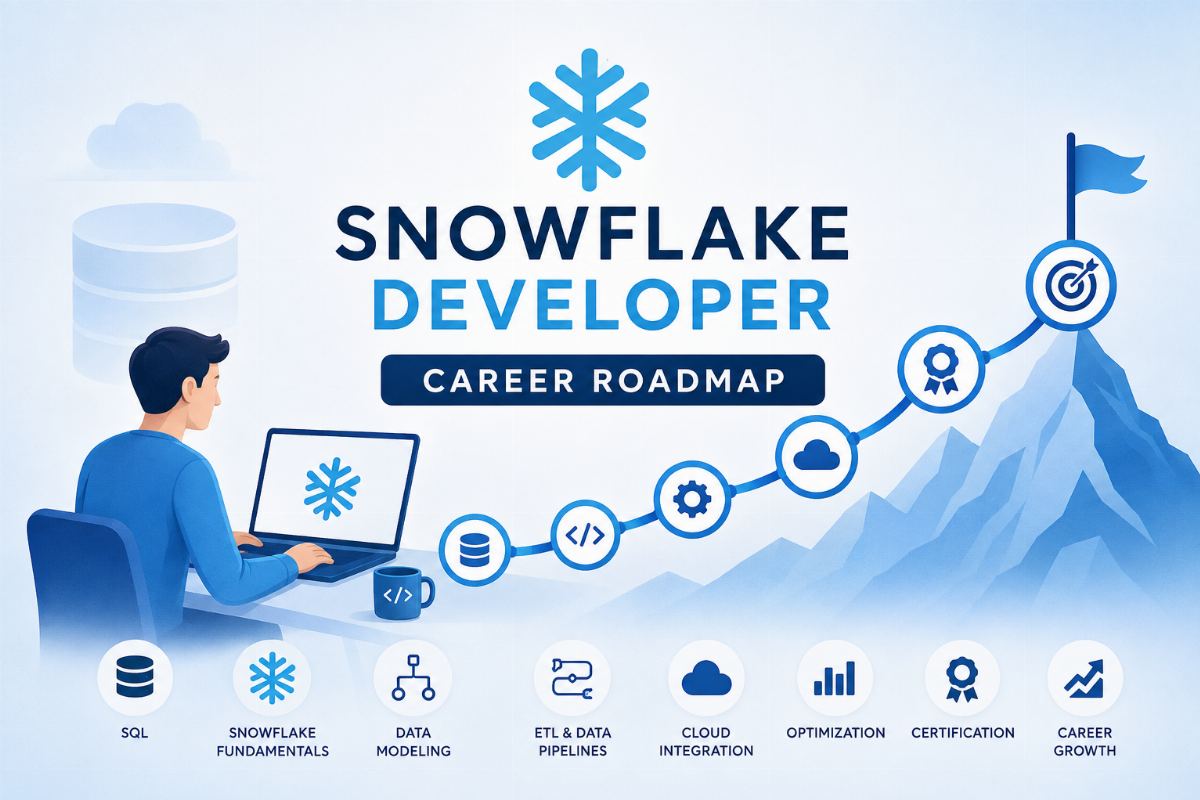
As organizations continue migrating to cloud-native data platforms, the demand for skilled Snowflake Developers has increased significantly across industries such as finance, healthcare, retail, e-commerce, manufacturing, and technology. Companies are actively seeking professionals who can design data models, develop ELT pipelines, optimize SQL queries, integrate cloud services, and ensure reliable data availability for business users.
Whether you're a student, software developer, database administrator, business intelligence professional, or aspiring data engineer, becoming a Snowflake Developer can open the door to rewarding career opportunities with competitive salaries and long-term growth. In this guide, you'll discover the complete learning path, essential technical skills, certifications, career roadmap, salary expectations, interview preparation strategies, and recommended courses to help you confidently start your Snowflake journey.
Whether you're a student, a working professional looking to upskill, or someone planning a career transition, this guide will help you to begin your Snowflake journey. With the right learning path and consistent practice, you can build a rewarding career in one of the fastest-growing areas of modern data technology.
What Does a Snowflake Developer Do?
A Snowflake Developer is responsible for designing, building, maintaining, and optimizing cloud-based data warehouse solutions using the Snowflake Data Cloud platform. Their primary goal is to ensure that organizations can efficiently store, process, transform, and analyze large volumes of structured and semi-structured data for reporting, business intelligence, and advanced analytics.
On a day-to-day basis, Snowflake Developers create and optimize SQL queries, design scalable database schemas, develop ELT pipelines, integrate data from multiple sources, and collaborate with data engineers, analysts, business stakeholders, and cloud architects. They also focus on improving query performance, managing security roles, implementing data governance practices, and automating repetitive workflows using modern cloud technologies.
As businesses increasingly rely on data-driven decision-making, Snowflake Developers play a critical role in delivering trusted, accessible, and high-quality data that powers dashboards, AI models, and enterprise applications. Their expertise bridges the gap between raw data and actionable business insights, making them an essential part of modern data engineering teams.
Why Choose a Snowflake Developer Career?
The rapid adoption of cloud computing, big data, artificial intelligence (AI), and real-time analytics has made Snowflake one of the most in-demand cloud data platforms worldwide. Organizations across finance, healthcare, retail, e-commerce, technology, telecommunications, and manufacturing are migrating from traditional on-premise databases to cloud-native data warehouses, creating a strong demand for skilled Snowflake Developers.
A career as a Snowflake Developer offers an excellent combination of high salary potential, global job opportunities, continuous learning, and long-term career growth. Since Snowflake integrates seamlessly with leading cloud platforms such as AWS, Microsoft Azure, and Google Cloud Platform (GCP), professionals with Snowflake expertise are valuable across a wide range of enterprise environments.
Is Snowflake a good career?
Snowflake skills complement broader data engineering, cloud, and analytics expertise. This means you can expand into roles such as Data Engineer, Cloud Data Engineer, Analytics Engineer, Data Architect, or even Solutions Architect as your experience grows.
- High demand across Fortune 500 companies and startups
- Excellent salary packages in the USA and globally
- Cloud-first technology with strong future growth
- Opportunities to work with AI, Machine Learning, and Big Data
- Flexible career progression into data engineering and cloud architecture
- Strong integration with modern analytics and BI platforms
Industries Hiring Snowflake Professionals
- Financial Services
- Healthcare
- Retail & E-commerce
- Insurance
- Manufacturing
- Logistics
- Telecommunications
- SaaS & Technology
- Government
- Consulting
What Are the Roles of a Snowflake Developer?
A Snowflake Developer transforms raw business data into reliable, secure, and accessible information that organizations can use for reporting, analytics, machine learning, and strategic decision-making.
Core Responsibilities:
Rather than simply writing SQL queries, modern Snowflake Developers collaborate with business analysts, data engineers, cloud architects, and software developers to build scalable data solutions that support enterprise applications.
Database Development
|
SQL Development
|
Data Integration
|
Performance Optimization
|
Security & Governance
|
Collaboration
|
Typical Daily Activities
|
Skills Required for a Snowflake Developer
To build a successful Snowflake career, you need more than platform knowledge. Employers seek professionals with a balanced mix of database, cloud, programming, analytics, and collaboration skills.
Technical Skills
Anyone looking for a career as a snowflake developer must have the following skills…
SQL (Must-Have)The foundation of every Snowflake Developer role. Topics to master:
|
Understanding of Snowflake Platform
|
Cloud ComputingGain working knowledge of:
Focus on:
|
ETL / ELTPopular tools include:
|
ProgrammingLanguages to learn:
Python is particularly valuable for automation, orchestration, and data processing. |
Learn Data Warehousing Concepts
|
Business IntelligenceFamiliarity with tools such as:
Understanding how business users consume data helps you design better warehouse solutions. |
Soft Skills Required for a Snowflake Developer
Technical expertise alone isn't enough. Successful Snowflake Developers also excel in following soft skills:
- Analytical thinking
- Problem-solving
- Communication
- Collaboration
- Documentation
- Attention to detail
- Time management
- Continuous learning
Most In-Demand Skill Combination
Professionals with the following stack are highly attractive to employers:
- Snowflake
- SQL
- Python
- Dbt
- Azure or AWS
- GitHub
- Airflow
- Power BI or Tableau
- Data Modeling
- ETL/ELT
- CI/CD basics
This combination aligns well with modern cloud data engineering teams and can significantly improve employability and salary potential.
Tools & Technologies Expertise for a Snowflake Developer
A successful Snowflake Developer is expected to work with a complete modern data stack rather than Snowflake alone. Organizations look for professionals who can build end-to-end data solutions by integrating cloud platforms, ETL tools, programming languages, databases, orchestration frameworks, and Business Intelligence (BI) tools.
Developing expertise in these technologies not only increases employability but also opens opportunities to transition into Data Engineering, Analytics Engineering, or Cloud Architecture roles.
Given below are the required tools & technologies any snowflake developer must have for better salary & growth..
|
Category |
Tools & Technologies |
|
Cloud Data Warehouse |
Snowflake |
|
Programming |
SQL, Python |
|
Cloud Platforms |
Microsoft Azure, AWS, Google Cloud |
|
ETL/ELT |
Azure Data Factory, dbt, Matillion, Informatica, Talend |
|
Data Engineering |
Apache Spark, PySpark |
|
Databases |
SQL Server, PostgreSQL, MySQL |
|
Version Control |
Git, GitHub |
|
BI & Visualization |
Power BI, Tableau, Looker |
|
Orchestration |
Apache Airflow |
|
API Tools |
REST APIs, Postman |
|
IDE |
VS Code, DataGrip |
|
Monitoring |
Snowflake Query History, Resource Monitors |
Also Know: Aspiring to Become a Data Engineer? Complete Learning Path, Career Roadmap & Certifications Needed
Recommended Learning Path/Order
Follow a structured Snowflake learning path: start with SQL and databases, then master Snowflake fundamentals, data warehousing, ETL, cloud integration, optimization, and hands-on projects to become job-ready.
Stage 1 – Database Fundamentals
|
Stage 2 – Programming
|
Stage 3 – Cloud Fundamentals
|
Stage 4 – Snowflake
|
Stage 5 – Data Engineering
|
Stage 6 – Analytics
|
Pro Tip: Employers value professionals who understand the entire data lifecycle—from ingestion and transformation to visualization and analytics—not just Snowflake itself.
Step-by-Step Roadmap for Snowflake Developer Course Learning Path
Becoming a Snowflake Developer doesn't require a computer science degree, but it does require a structured learning path. The roadmap below is designed for beginners and can also help software developers, database professionals, or data analysts transition into cloud data engineering.
Phase 1: Build Strong Foundations (2–4 Weeks)
Start with the basics of databases and SQL.
Learn:
- Database Concepts
- SQL Fundamentals
- Joins
- Views
- Indexes
- Stored Procedures
- Query Optimization
Outcome: You should be comfortable writing SQL queries and understanding relational databases.
Phase 2: Learn Python (3–4 Weeks)
Python is widely used for data automation, scripting, APIs, and ETL.
Focus On:
- Variables
- Loops
- Functions
- File Handling
- Pandas Basics
- APIs
- Exception Handling
Mini Project: Read CSV files and load data into a database.
Phase 3: Learn Cloud Fundamentals (2–3 Weeks)
Understand how cloud platforms work before diving into Snowflake.
Topics:
- Azure or AWS Basics
- Cloud Storage
- IAM
- Virtual Machines
- Networking Basics
Phase 4: Master Snowflake (4–6 Weeks)
Learn the Snowflake platform in depth.
Topics:
- Snowflake Architecture
- Databases & Schemas
- Virtual Warehouses
- SQL Development
- Time Travel
- Zero Copy Cloning
- Streams & Tasks
- Snowpipe
- Security & RBAC
- Performance Tuning
- Cost Optimization
Phase 5: Learn Data Engineering (4–6 Weeks)
Expand your expertise beyond Snowflake.
Learn:
- ETL/ELT
- dbt
- Azure Data Factory
- Apache Airflow
- Data Pipelines
- Data Warehousing Concepts
- PySpark Basics
Phase 6: Build Real Projects
Portfolio projects significantly improve your chances of getting interviews.
Suggested Projects
- Sales Analytics Data Warehouse
- Healthcare Data Warehouse
- Retail Dashboard
- HR Analytics
- Finance Reporting System
- Customer 360 Platform
- ETL Pipeline using Snowflake + dbt
- Snowflake + Power BI Dashboard
Phase 7: Prepare for Interviews
Practice following:
- SQL Coding
- Snowflake Scenarios
- ETL Concepts
- Data Modeling
- Cloud Fundamentals
- Python Coding
Phase 8: Earn Certifications
Complete relevant certifications to validate your skills and improve your resume.
Recommended Learning Timeline
Learning time varies by background: Beginners: 4–6 months, working IT professionals: 2–4 months, and database professionals: 1–3 months with consistent hands-on practice.
|
Experience |
Estimated Duration |
|
Beginner |
4–6 Months |
|
Working Professional |
3–4 Months |
|
Database Professional |
2–3 Months |
Snowflake Developer vs Snowflake Data Engineer
Many learners confuse these two career paths. While both work with Snowflake, their responsibilities, skill sets, and project scope differ.
Snowflake Developers primarily focus on designing, developing, and optimizing Snowflake databases and SQL solutions, whereas Snowflake Data Engineers build scalable data pipelines, integrate multiple data sources, and manage enterprise data architectures.
Comparison Table |
||
|
Feature |
Snowflake Developer |
Snowflake Data Engineer |
|
Primary Focus |
Snowflake Development |
End-to-End Data Pipelines |
|
SQL |
⭐⭐⭐⭐⭐ |
⭐⭐⭐⭐⭐ |
|
Python |
⭐⭐⭐ |
⭐⭐⭐⭐⭐ |
|
PySpark |
Basic |
Advanced |
|
ETL |
Medium |
Advanced |
|
Data Warehousing |
High |
High |
|
Cloud Platforms |
Medium |
High |
|
Airflow |
Basic |
Advanced |
|
DBT |
Medium |
High |
|
Big Data |
Medium |
High |
|
Architecture |
Medium |
High |
|
Salary Potential |
High |
Very High |
Choose Snowflake Developer as Career If You:
- Enjoy SQL development
- Like database optimization
- Prefer analytics and reporting
- Want to specialize in cloud data warehousing
Choose Data Engineer as Career If You:
- Enjoy programming
- Like automation
- Want to build large-scale pipelines
- Work with Big Data technologies
- Want broader cloud engineering responsibilities
Also Read: How to Become a Big Data Engineer: Learning Path, Career Roadmap, Certifications & Skills
Recommended Snowflake Certifications to Consider
Professional snowflake certifications help validate your technical knowledge and demonstrate commitment to continuous learning. While certifications alone won't guarantee a job, they can strengthen your resume and complement hands-on project experience.
Certification Path for Snowflake Developer
Beginner
- Snowflake Hands-on Training
- SQL Fundamentals
- Cloud Fundamentals (Azure or AWS)
Intermediate
- SnowPro® Core Certification
- Azure Fundamentals (AZ-900)
- AWS Certified Cloud Practitioner
Advanced
- SnowPro Advanced Certifications
- Azure Data Engineer Associate (DP-203)
- AWS Data Analytics Specialty (if aligned with your cloud platform)
Following are the complementary certifications to consider
- dbt Fundamentals
- Microsoft Power BI Data Analyst
- Tableau Desktop Specialist
- Apache Spark Certifications
Suggested Certification Order
- SQL Fundamentals
- Cloud Fundamentals
- SnowPro Core
- Azure or AWS
- dbt
- Power BI
- Apache Spark / PySpark
Recommended Courses for Snowflake Career Path from Vaanii
To build a complete Snowflake career path, learners should complement Snowflake with foundational and adjacent technologies:
- SQL – Build strong database querying skills.
- Python – Automate workflows and work with data efficiently.
- Azure Cloud – Understand cloud infrastructure and services.
- ETL Tools – Learn modern data integration and transformation.
- Git & GitHub – Manage code, collaboration, and version control.
- PySpark – Extend into large-scale data processing and engineering.
Following this sequence helps learners become well-rounded cloud data professionals rather than specialists in a single tool.
Snowflake Developer Interview Questions for Beginners
Preparing for interviews is just as important as learning the technology. Recruiters evaluate not only your knowledge of Snowflake but also your understanding of SQL, cloud fundamentals, data warehousing concepts, ETL processes, and problem-solving skills. Practicing common interview questions and building hands-on projects will significantly improve your confidence and increase your chances of landing your first Snowflake Developer role.
Beginner-Level Questions
- What is Snowflake, and why is it used?
- Explain Snowflake Architecture.
- What are Virtual Warehouses?
- Difference between Database, Schema, and Warehouse?
- What is Time Travel in Snowflake?
- What is Zero Copy Cloning?
- Explain Micro-partitions.
- What is Snowpipe?
- Difference between ETL and ELT?
- Explain Role-Based Access Control (RBAC).
SQL Questions
- Difference between JOINs
- Explain Window Functions
- What is a CTE?
- Difference between DELETE, TRUNCATE, and DROP
- Explain Primary Key vs Foreign Key
- Write a query to find duplicate records
- Explain Query Optimization
Scenario-Based Questions
- How would you optimize a slow query?
- How would you migrate data from SQL Server to Snowflake?
- How would you secure sensitive customer data?
- How would you automate daily data loads?
- How would you design a reporting data warehouse?
Tips to Crack Snowflake Interviews
- Practice SQL daily
- Build 3–5 real-world projects
- Learn cloud fundamentals
- Understand Snowflake architecture
- Revise data warehousing concepts
- Prepare business scenarios
- Showcase GitHub projects
- Stay updated with Snowflake releases
Snowflake Developer Career Prospects & Future Scope
As organizations increasingly embrace cloud-native data platforms, the demand for Snowflake Developers continues to grow across industries. Snowflake has become a preferred data cloud solution for enterprises due to its scalability, security, and seamless integration with cloud providers like AWS, Microsoft Azure, and Google Cloud Platform.
Professionals with Snowflake expertise are no longer limited to database development roles. By combining Snowflake with SQL, Python, cloud computing, ETL, and analytics tools, you can progress into higher-paying and more strategic positions in data engineering, cloud architecture, and analytics leadership.
Snowflake Career Future Career Growth Path
As your expertise grows, you can transition into:
Junior Snowflake Developer
↓
Snowflake Developer
↓
Senior Snowflake Developer
↓
Data Engineer
↓
BI Engineer
↓
Senior Data Engineer
↓
Cloud Data Engineer
↓
Analytics Engineer
↓
Data Warehouse Architect
↓
Data Platform Engineer
↓
Cloud Solutions Architect
Future Skills Worth Learning
To stay competitive, continue building skills in:
- Python
- PySpark
- Databricks
- dbt
- Apache Airflow
- Microsoft Fabric
- Azure Data Factory
- AWS Data Services
- Power BI
- Tableau
- Generative AI for Data Analytics
- Data Governance
These complementary technologies will help you adapt to evolving industry requirements and open doors to more advanced roles.
Snowflake Developer Salary in USA
Snowflake Developers are among the highest-paid professionals in the data engineering ecosystem due to the increasing demand for cloud-native data warehousing expertise. Salaries vary depending on experience, certifications, location, industry, and technical skill set.
Professionals who combine Snowflake with SQL, Python, ETL tools, cloud platforms (AWS/Azure/GCP), and data engineering technologies often command significantly higher compensation than those with only database administration experience.
Average Salary by Experience
|
Experience |
Estimated Annual Salary (USD) |
|
Entry Level (0–2 Years) |
$85,000–$115,000 |
|
Mid-Level (3–5 Years) |
$115,000–$145,000 |
|
Senior (5–8 Years) |
$145,000–$175,000 |
|
Lead / Architect (8+ Years) |
$175,000–$220,000+ |
Top Paying Locations
- California
- Washington
- New York
- Texas
- Virginia
- Massachusetts
- North Carolina
Factors That Increase Salary
- Snowflake Certification
- Advanced SQL expertise
- Python programming
- Data Modeling
- ETL/ELT experience
- AWS or Azure certifications
- Databricks experience
- dbt knowledge
- Airflow
- CI/CD automation
- Real-world project portfolio
Career Tips: Don't position yourself as "only a Snowflake Developer." Employers increasingly prefer professionals who can work across the modern data stack, including cloud platforms, orchestration tools, and data engineering frameworks.
Frequently Asked Questions
Q1. Is Snowflake a good career in 2026?
Yes. Snowflake skills remain in high demand as organizations continue migrating to cloud-native data platforms. Combined with SQL, cloud computing, and data engineering skills, Snowflake offers excellent long-term career growth.
Q2. Do I need programming knowledge to become a Snowflake Developer?
Basic SQL is essential, and Python is highly recommended for automation and data processing. While you can start with SQL alone, learning Python will significantly broaden your career opportunities.
3. How long does it take to become a Snowflake Developer?
With consistent learning and hands-on practice, beginners can develop job-ready skills in approximately 4–6 months. Professionals with prior SQL or database experience may progress more quickly.
4. Is Snowflake difficult to learn?
Snowflake is considered beginner-friendly compared to many enterprise data platforms. A solid understanding of SQL and database concepts makes learning Snowflake much easier.
5. Which cloud platform should I learn with Snowflake?
Snowflake works seamlessly with AWS, Microsoft Azure, and Google Cloud Platform. Choosing one cloud platform based on your career goals is a practical starting point.
6. Can beginners get a Snowflake Developer job?
Yes. Employers often hire entry-level candidates who demonstrate strong SQL skills, practical projects, cloud fundamentals, and a willingness to learn.
7. Which certifications are best for Snowflake Developers?
A strong certification path includes SnowPro® Core, Azure Fundamentals (AZ-900) or AWS Cloud Practitioner, followed by advanced certifications based on your chosen specialization.
8. What projects should I build before applying for jobs?
Create practical projects such as sales analytics dashboards, ETL pipelines, customer analytics platforms, finance reporting systems, and data warehouses using Snowflake, SQL, and cloud services.
9. Can Snowflake Developers transition into Data Engineering?
Absolutely. Many Snowflake Developers naturally progress into Data Engineering by adding skills like PySpark, ETL, dbt, Airflow, and cloud architecture.
10. Does Vaanii offer Snowflake training for beginners?
Yes. Vaanii provides beginner-friendly and career-focused learning paths covering SQL, Snowflake, cloud platforms, data engineering, and related technologies to help learners build practical, job-ready skills.
Conclusion
A career as a Snowflake Developer offers an exciting opportunity to work at the intersection of cloud computing, data engineering, analytics, and modern business intelligence. As organizations increasingly rely on cloud-native data platforms, professionals with expertise in Snowflake, SQL, cloud technologies, and data integration continue to enjoy strong demand, competitive salaries, and diverse career opportunities.
By building a strong foundation in SQL, Python, cloud computing, ETL processes, data modeling, and real-world projects, you can develop the practical expertise employers value. Continuous learning, hands-on experience, and industry-recognized certifications will further strengthen your profile
Discussion
Be the first to share your thoughts.