
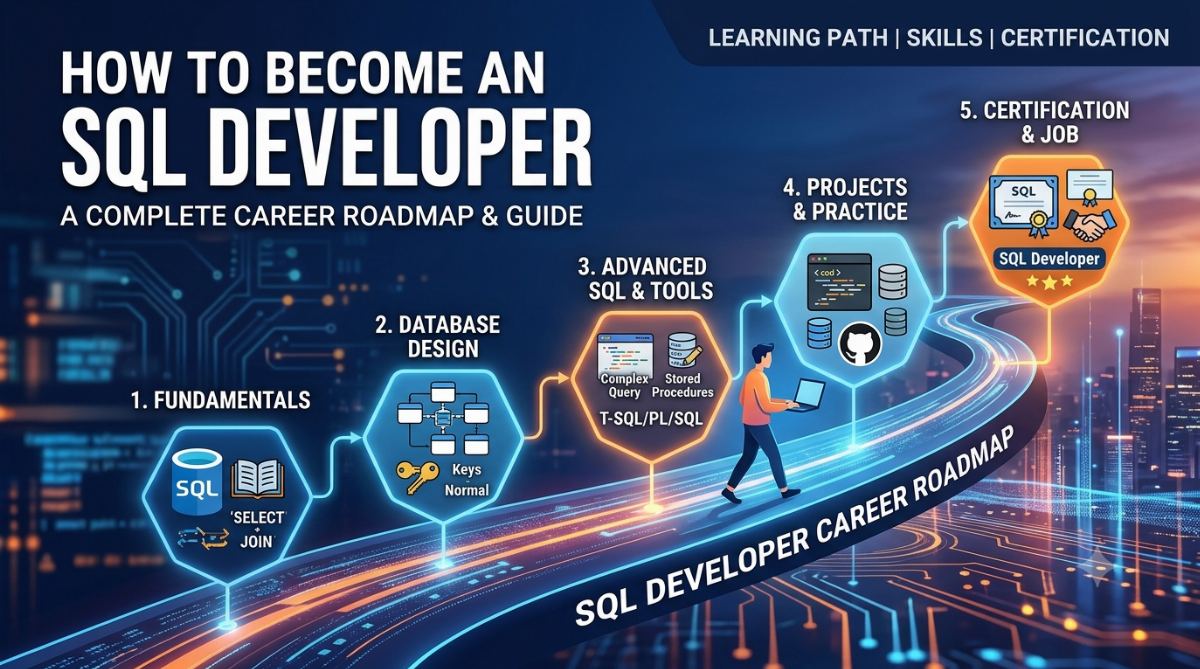
Today organizations continue to depend on data-driven applications and digital business operations, the demand for skilled SQL Developers remains important across industries such as banking, healthcare, retail, e-commerce, manufacturing, telecommunications, and technology. Companies need professionals who can design databases, develop efficient SQL queries, manage large datasets, optimize database performance, and ensure reliable access to business information.
Whether you are a student, software developer, database administrator, data analyst, or working IT professional, becoming an SQL Developer can open opportunities in database development, data engineering, business intelligence, and analytics. In this guide, you will explore the complete learning path, essential technical skills, recommended tools, certifications, career roadmap, salary factors, and interview preparation strategies to help you build a successful SQL Developer career.
What Does an SQL Developer Do?
An SQL Developer is responsible for designing, developing, maintaining, and optimizing relational database systems. Their primary goal is to ensure that organizations can store, retrieve, update, and manage data efficiently and securely.
On a day-to-day basis, SQL Developers write complex SQL queries, design database tables, develop stored procedures and functions, create views, optimize query performance, and troubleshoot database-related issues. They also collaborate with software developers, database administrators, data engineers, business analysts, and project managers to support business applications and reporting requirements.
SQL Developers work with database platforms such as Oracle, Microsoft SQL Server, MySQL, PostgreSQL, and IBM Db2.
Why Choose a SQL Developer Career?
SQL continues to be one of the most widely used technologies in the IT industry. Almost every organization that manages structured information depends on databases for its business operations. [Also Read: How to Become a Snowflake Developer: Career Roadmap, Learning Path, Skills & Certification Guide]
A career as an SQL Developer offers opportunities to work across different industries, develop strong technical expertise, and transition into advanced database and data engineering roles. Follwoing industries are hiring SQL developers
- Banking and Financial Services
- Healthcare
- Retail and E-commerce
- Insurance
- Manufacturing
- Telecommunications
- Education
- Logistics and Supply Chain
- Government Organizations
- IT Services and Consulting
Technical & Soft Skills Required for an SQL Developer
To build a successful SQL Developer career, professionals need a combination of database knowledge, programming skills, analytical thinking, and practical experience.
Must have Proficiency in SQL
SQL is the foundation of SQL development. Important topics include:
- SELECT, INSERT, UPDATE, DELETE
- WHERE, GROUP BY, ORDER BY
- INNER JOIN, LEFT JOIN, RIGHT JOIN
- Subqueries and Common Table Expressions (CTEs)
- Window Functions
- Views and Indexes
- Stored Procedures and Functions
- Triggers
- Query Optimization
How to Use Database Management Systems
Gain practical knowledge of at least one major relational database platform:
- Oracle Database
- Microsoft SQL Server
- MySQL
- PostgreSQL
- IBM Db2
Database Design & Modelling
Learn the following concepts:
- Database Architecture
- Entity Relationship Diagrams (ERD)
- Primary and Foreign Keys
- Normalization and Denormalization
- One-to-One, One-to-Many, and Many-to-Many Relationships
- Data Integrity and Constraints
Programming Knowledge
Useful programming languages include:
- SQL ⭐⭐⭐⭐⭐
- PL/SQL ⭐⭐⭐⭐⭐ (Oracle environments)
- T-SQL ⭐⭐⭐⭐⭐ (Microsoft SQL Server)
- Python ⭐⭐⭐⭐
- Shell Scripting ⭐⭐⭐
Performance Tuning
Understand following:
- Indexing Strategies
- Execution Plans
- Query Optimization
- Database Statistics
- Transaction Management
- Locking and Concurrency
Cloud Database Knowledge
Gain working knowledge of cloud database services such as:
- Amazon RDS
- Azure SQL Database
- Google Cloud SQL
- Oracle Autonomous Database
Soft Skills Required for SQL Developer
Technical expertise alone is not enough. Successful SQL Developers also need:
- Analytical Thinking
- Problem-Solving
- Communication
- Team Collaboration
- Attention to Detail
- Documentation
- Time Management
- Continuous Learning
Most In-Demand Skill Combination for SQL Developer
Professionals with the following combination can build a strong technical profile:
- SQL
- Oracle or SQL Server
- PL/SQL or T-SQL
- Python
- Database Design
- Performance Tuning
- ETL/ELT Fundamentals
- Git and GitHub
- Cloud Database Knowledge
- Power BI or Tableau
Tools & Technologies Expertise for SQL Developers
Modern SQL Developers work with database platforms, development environments, performance monitoring tools, and reporting technologies.
|
Category |
Tools & Technologies |
|
Database Platforms |
Oracle, SQL Server, MySQL, PostgreSQL |
|
SQL Development |
Oracle SQL Developer, SSMS, MySQL Workbench |
|
Programming |
SQL, PL/SQL, T-SQL, Python |
|
Cloud Platforms |
AWS, Microsoft Azure, Google Cloud |
|
Database Design |
Erwin Data Modeler, dbdiagram.io |
|
ETL Tools |
Informatica, Talend, Azure Data Factory |
|
Version Control |
Git, GitHub |
|
BI and Reporting |
Power BI, Tableau |
|
Development Environments |
Visual Studio Code, DataGrip |
|
Performance Monitoring |
Query Execution Plans, Database Monitoring Tools |
Recommended SQL Developer Learning Path
Follow a structured learning path to become an SQL Developer. Start with database fundamentals, then learn SQL programming, database development, performance optimization, and advanced database technologies. [Also Read: How to Become a Big Data Engineer: Learning Path, Career Roadmap, Certifications & Skills ]
Stage 1 – Database Fundamentals
- Database Concepts
- Relational Database Management Systems
- Tables, Rows, and Columns
- Primary and Foreign Keys
- Database Relationships
Stage 2 – SQL Fundamentals
- SELECT Statements
- Filtering and Sorting
- INSERT, UPDATE, DELETE
- Aggregate Functions
- GROUP BY and HAVING
Stage 3 – Intermediate SQL
- Different Types of JOINs
- Subqueries
- CTEs
- Views
- Indexes
- Set Operators
Stage 4 – Advanced SQL
- Window Functions
- Stored Procedures
- Functions
- Triggers
- Transactions
- Error Handling
Stage 5 – Database Development
- Database Design
- Data Modeling
- Normalization
- Query Execution Plans
- Performance Tuning
- Security and Permissions
Stage 6 – Programming and Automation
- PL/SQL or T-SQL
- Python Fundamentals
- Database Connectivity
- Automation Scripts
- Git and GitHub
Stage 7 – Advanced Technologies
- Cloud Databases
- ETL/ELT
- Database Migration
- Data Warehousing
- Business Intelligence
- AI-Assisted SQL Development
Step-by-Step Roadmap to Become an SQL Developer
Becoming an SQL Developer does not necessarily require an advanced computer science degree. However, it requires structured learning, regular practice, and hands-on experience.
Phase 1: Build Strong Database Foundations (2–3 Weeks)
Start by understanding how relational databases work.
Learn:
- Database Concepts
- RDBMS Fundamentals
- Tables and Relationships
- Primary and Foreign Keys
- Database Constraints
Outcome: Understand how data is organized and stored in relational databases.
Phase 2: Master SQL Fundamentals (3–4 Weeks)
Learn how to retrieve and manipulate information using SQL.
Focus On:
- SELECT Statements
- WHERE Conditions
- INSERT, UPDATE, DELETE
- Aggregate Functions
- GROUP BY and ORDER BY
- Basic JOINs
Mini Project: Create an Employee Management Database and perform basic employee record operations.
Phase 3: Learn Intermediate and Advanced SQL (4–5 Weeks)
Develop the ability to write complex SQL queries.
Topics:
- INNER and OUTER JOINs
- Subqueries and CTEs
- Window Functions
- Views and Indexes
- Stored Procedures
- Functions and Triggers
Mini Project: Build a Sales Reporting System that calculates total sales, monthly revenue, and customer performance.
Phase 4: Learn a Database Platform (3–4 Weeks)
Choose one major database platform and gain hands-on experience.
Recommended Platforms:
- Oracle Database
- Microsoft SQL Server
- MySQL
- PostgreSQL
Focus On:
- Database Administration Basics
- Schema Management
- User Permissions
- Backup and Recovery Concepts
- Transaction Management
- Database Monitoring
Phase 5: Learn Performance Optimization (2–3 Weeks)
Understanding performance is an important part of professional SQL development.
Learn:
- Indexing Strategies
- Execution Plans
- Query Optimization
- Database Statistics
- Locking and Deadlocks
- Performance Troubleshooting
Mini Project: Identify slow-running queries in a sample database and improve their performance.
Phase 6: Learn Programming and Integration (3–4 Weeks)
Expand your knowledge beyond SQL.
Learn:
- PL/SQL or T-SQL
- Python Basics
- Database Connectivity
- ETL Fundamentals
- Git and GitHub
Mini Project: Develop a Python script that reads information from a CSV file and loads it into a relational database.
Phase 7: Build Real-World Projects
Practical projects help demonstrate your technical knowledge to employers.
Suggested Projects:
- Employee Management System
- Banking Transaction Database
- E-commerce Order Management System
- Hospital Management Database
- Inventory Management System
- Sales and Revenue Reporting System
- Customer Relationship Management Database
- HR Analytics Database
Phase 8: Prepare for Interviews and Certifications
Prepare for technical interviews by practicing SQL queries, database concepts, optimization scenarios, and real-world problems.
Earn relevant certifications to validate your knowledge and strengthen your professional profile.
Learning Timeline for Job Ready SQL Developer
The time required to become job-ready depends on your previous experience, learning speed, and practical exposure.
|
Experience Level |
Estimated Duration |
|
Beginner |
4–6 Months |
|
Working IT Professional |
3–4 Months |
|
Database Professional |
2–3 Months |
Note: These are indicative learning timelines and assume consistent practice.
Difference: SQL Developer vs Database Administrator (DBA)
Many beginners confuse SQL Developers with Database Administrators. Although both work with databases, their responsibilities and primary focus are different.
|
Feature |
SQL Developer |
Database Administrator |
|
Primary Focus |
Database Development |
Database Administration |
|
SQL Queries |
Advanced |
Working Knowledge |
|
Stored Procedures |
High Focus |
Limited/As Required |
|
Database Design |
High Focus |
Supporting Role |
|
Performance Tuning |
Query Optimization |
Overall Database Performance |
|
Backup and Recovery |
Basic Knowledge |
High Focus |
|
Security |
Application-Level Database Access |
Database Security and Access Management |
|
Database Monitoring |
Development Requirements |
High Focus |
|
Main Objective |
Develop Database Solutions |
Maintain Database Availability and Reliability |
Choose SQL Developer as a Career If You:
- Enjoy writing SQL queries.
- Like database programming and logical problem-solving.
- Want to develop database-driven applications.
- Enjoy data analysis and query optimization.
Choose Database Administrator as a Career If You:
- Prefer database infrastructure management.
- Enjoy backup and recovery operations.
- Like database security and availability management.
- Want to specialize in database administration.
SQL Developer Certification Roadmap
Professional certifications can help validate database knowledge and demonstrate technical skills to employers. Certifications should complement practical experience and real-world projects. Given below is the suggested certification order basis the beginner, intermediate & professional level.
SQL Fundamentals (Beginner level):
Kickstart your database journey with foundational courses and certifications from industry leaders.
- Oracle SQL Explorer – Free learning and badge
- Oracle Database SQL Certification
- Microsoft SQL Learning
Database Platform Fundamentals (Beginner to intermediate):
Given below are the platforms to get mastery...
- Oracle Database
- Microsoft SQL Server
- MySQL Training
Cloud Fundamentals (Intermediate):
Get mastery on following cloud platforms & fundamentals..
- Microsoft Azure
- AWS
- Oracle Cloud Infrastructure
Database Administration or Development Specialization (Professional level):
To become professional SQL developer, aspirants should learn following...
- Azure Database Administrator Associate
- Oracle Database SQL
- Oracle Database PL/SQL
- MySQL Database Administration / Development
Advanced Database and Cloud Technologies (Advanced level):
For advance database, cloud related technologies etc, learn following
- Oracle Database Advanced Training
- Azure SQL Advanced Learning
- AWS Database Services
- Oracle Multi cloud Foundations
Sample SQL Developer Interview Questions
Interview preparation is an important part of becoming an SQL Developer. Employers evaluate SQL knowledge, database concepts, query-writing abilities, troubleshooting, and practical problem-solving skills.
Beginner-Level Questions
- What is SQL, and why is it used?
- What is the difference between SQL and a database?
- What is an RDBMS?
- What are Primary Keys and Foreign Keys?
- What is the difference between DELETE, TRUNCATE, and DROP?
- What is database normalization?
- What are SQL constraints?
- What is the difference between WHERE and HAVING?
- What are aggregate functions?
- What is the difference between CHAR and VARCHAR?
Intermediate & Advanced SQL Questions
- Explain different types of JOINs.
- What is a Common Table Expression (CTE)?
- What are Window Functions?
- What is the difference between a Stored Procedure and a Function?
- What is an Index, and how does it improve performance?
- How do you identify duplicate records?
- How do you find the second-highest salary?
- What is a database transaction?
- Explain COMMIT and ROLLBACK.
- How do you optimize a slow-running SQL query?
Scenario-Based Questions
- How would you identify duplicate customer records in a database?
- How would you optimize a query that takes several minutes to execute?
- How would you manage a database containing millions of records?
- How would you maintain data consistency during multiple transactions?
- How would you design an employee management database?
- How would you troubleshoot database performance issues?
Tips to Crack SQL Developer Interviews
- Practice SQL queries regularly.
- Understand database fundamentals.
- Build at least 3–5 practical projects.
- Practice complex JOINs and Window Functions.
- Understand query execution plans.
- Prepare real-world database scenarios.
- Learn one database platform in depth.
- Maintain a portfolio of practical work.
SQL Developer Career Prospects & Future Scope
SQL remains a fundamental technology in modern enterprise applications and data management systems. As businesses generate increasing amounts of information, the need for professionals who can manage, organize, and optimize databases continues across industries.
SQL Developers can expand their careers beyond traditional database development by learning cloud technologies, data engineering, automation, and artificial intelligence.
SQL Developer Career Growth Path
Given below is the career growth as a SQL Developer you can expect.
Future Skills Worth Learning to Become SQL Developer
To remain competitive in the technology industry, SQL Developers should continue developing skills in:
- Python Programming
- Cloud Database Services
- Database Automation
- Data Engineering
- ETL/ELT Tools
- Data Warehousing
- Big Data Technologies
- Power BI and Tableau
- Generative AI for SQL Development
- Database Security and Governance
These complementary skills can create opportunities in advanced database development, cloud data engineering, and enterprise architecture.
SQL Developer Salary in USA
SQL Developer salaries vary depending on experience, location, industry, database platform, certifications, and technical specialization. Average SQL Developer Salary by Experience in USA
|
Experience |
Estimated Annual Salary (USD) |
|
Entry Level (0–2 Years) |
$65,000–$90,000 |
|
Mid-Level (3–5 Years) |
$85,000–$115,000 |
|
Senior (5–8 Years) |
$100,000–$135,000 |
|
Lead / Architect (8+ Years) |
$120,000–$160,000+ |
Factors That Influence Salary
- Years of Professional Experience
- Advanced SQL and Database Knowledge
- Oracle, SQL Server, or PostgreSQL Expertise
- Performance Tuning Experience
- Cloud Database Skills
- Python and Programming Knowledge
- Professional Certifications
- Real-World Project Experience
Career growth and salary potential generally improve as professionals develop advanced technical expertise and take ownership of complex database solutions.
Frequently Asked Questions (FAQs)
Q1. Is SQL Developer a good career ahead?
Yes, SQL development continues to be relevant across industries because organizations depend on databases to manage business information, transactions, and applications. Combining SQL with cloud technologies and data engineering can provide additional career opportunities.
Q2. Do I need programming knowledge to become an SQL Developer?
Strong SQL knowledge is essential. Learning PL/SQL, T-SQL, or Python can further improve your development and automation capabilities.
Q3. How long does it take to become an SQL Developer?
Beginners can typically build foundational and job-oriented skills in approximately 4–6 months with consistent learning and hands-on practice. Professionals with previous database experience may progress faster.
Q4. Is SQL difficult to learn?
SQL is generally considered beginner-friendly. Basic commands are relatively easy to understand, while advanced topics such as query optimization, window functions, stored procedures, and database architecture require more practice.
Q5. Which database should I learn first?
Oracle, Microsoft SQL Server, MySQL, and PostgreSQL are all useful choices. Beginners can start with MySQL or PostgreSQL, while professionals should select a platform based on their target industry and job requirements.
Q6. Can beginners get an SQL Developer job?
Yes. Beginners can apply for entry-level opportunities by demonstrating strong SQL fundamentals, database concepts, practical projects, and problem-solving skills.
Q7. Which certifications are best for SQL Developers?
Relevant options include Oracle database certifications, Microsoft Azure database certifications, and foundational cloud certifications. The best choice depends on your preferred database platform and career goals.
Q8. What projects should I build before applying for SQL Developer jobs?
You can build projects such as Employee Management Systems, Banking Databases, E-commerce Order Management Systems, Hospital Management Databases, and Sales Reporting Systems.
Q9. Can SQL Developers move into Data Engineering?
Absolutely. SQL Developers can transition into Data Engineering by learning Python, ETL/ELT processes, data pipelines, cloud platforms, and big data technologies.
Q10. Will Artificial Intelligence replace SQL Developers?
AI can automate certain SQL-writing and query-assistance tasks, but database design, performance optimization, data security, troubleshooting, and business understanding still require professional expertise. Developers who learn to use AI effectively can improve their productivity.
Conclusion
A career as an SQL Developer offers an excellent opportunity to work with databases, enterprise applications, data management, and modern business technologies. As organizations continue to depend on structured information, professionals with strong SQL and database development skills remain valuable across different industries.
By building a solid foundation in SQL, learning database platforms, understanding performance optimization, and developing practical projects, beginners can establish the technical knowledge required to enter this field.
Continuous learning, practical experience, and industry-relevant certifications can help you become a skilled SQL Developer and progress toward advanced roles in database engineering and enterprise data architecture.
Experienced professionals can further strengthen their careers by exploring cloud databases, Python, automation, data engineering, and AI-assisted development.
Start with SQL fundamentals, practice consistently, build real-world projects, and take the next step toward becoming a successful SQL Developer.
Discussion
Be the first to share your thoughts.