Current Level 0: Python Level - 0
0 / 6 Miles
0 / 6 Assignments
0 / 6 Exams

Mile 1: Introduction to Python & Career Paths

🎬 YouTube Videos

No YouTube videos available

Check back later for new YouTube content.

📹 Library Videos

Python Mile #1: What is Python: Library Video

📚 Content

SECTION 1 WHAT IS PYTHON?

45 min read


What is Python?

snake What is Python?

Imagine talking to a computer like you talk to your friend... That's exactly what Python feels like.

Python is a programming language created by Guido van Rossum in 1991.

It was designed so that even beginners can read and understand code easily.

Think of it like this:
Other languages = strict grammar
Python = simple English

Remember This

Python = English + Logic
If you can think clearly, you can code in Python.

Live Python Snake
Simple to read.
Powerful to build.
Python bridges the gap between human thinking and computer instructions — clearly, simply, and elegantly.
Created 1991 Guido van Rossum Open Source
mending heartWhy Python is So Easy (and Fun!)
01 read
Reads Like English
Even beginners can often guess what Python code does.
02 run
No Waiting
Write and run instantly — great for testing ideas fast.
03 works
Works Everywhere
Windows, Mac, Linux — same Python, any device.
04 styles
Many Styles
Code in different ways depending on the problem.
05 build
Build Anything
Websites, games, data, AI and more.
read


laptop Your First Python Code

Here is the first Python line every student sees:


print("Hello, Python!")


light bulb
Try It

This tells the computer to display a message on screen. Type it in the IDE below and run it yourself!

person running Try It Yourself — Python IDE
# Type your first Python program here
# Try:
# print("Hello, Python!")


building construction What Can You Build With Python?
Web

Create websites and full web applications with frameworks like Django and Flask.

Games

Make fun game projects using libraries like Pygame.

Data

Analyze numbers, build charts, and find patterns in data.

AI

Build smart tools and intelligent systems used by companies worldwide.

sparkles Final Idea to Remember
1

Python is easy to start because the code is designed to be readable and beginner-friendly.

2

Python is powerful too — the same language is used for beginner practice and real-world projects.

backhand index pointing right
Smart Takeaway

Python is not about memorizing everything. It is about thinking clearly and writing simply.

check Copied!

3 min read

What is Python?
Python is a high-level, interpreted programming language created by Guido van Rossum and first released in 1991.
Unlike low-level languages (like C or Assembly)

Python was designed to be :

  • Easy to read,
  • Easy to write, and
  • Beginner-friendly.

Its syntax looks close to plain English, making it approachable for first-time programmers.
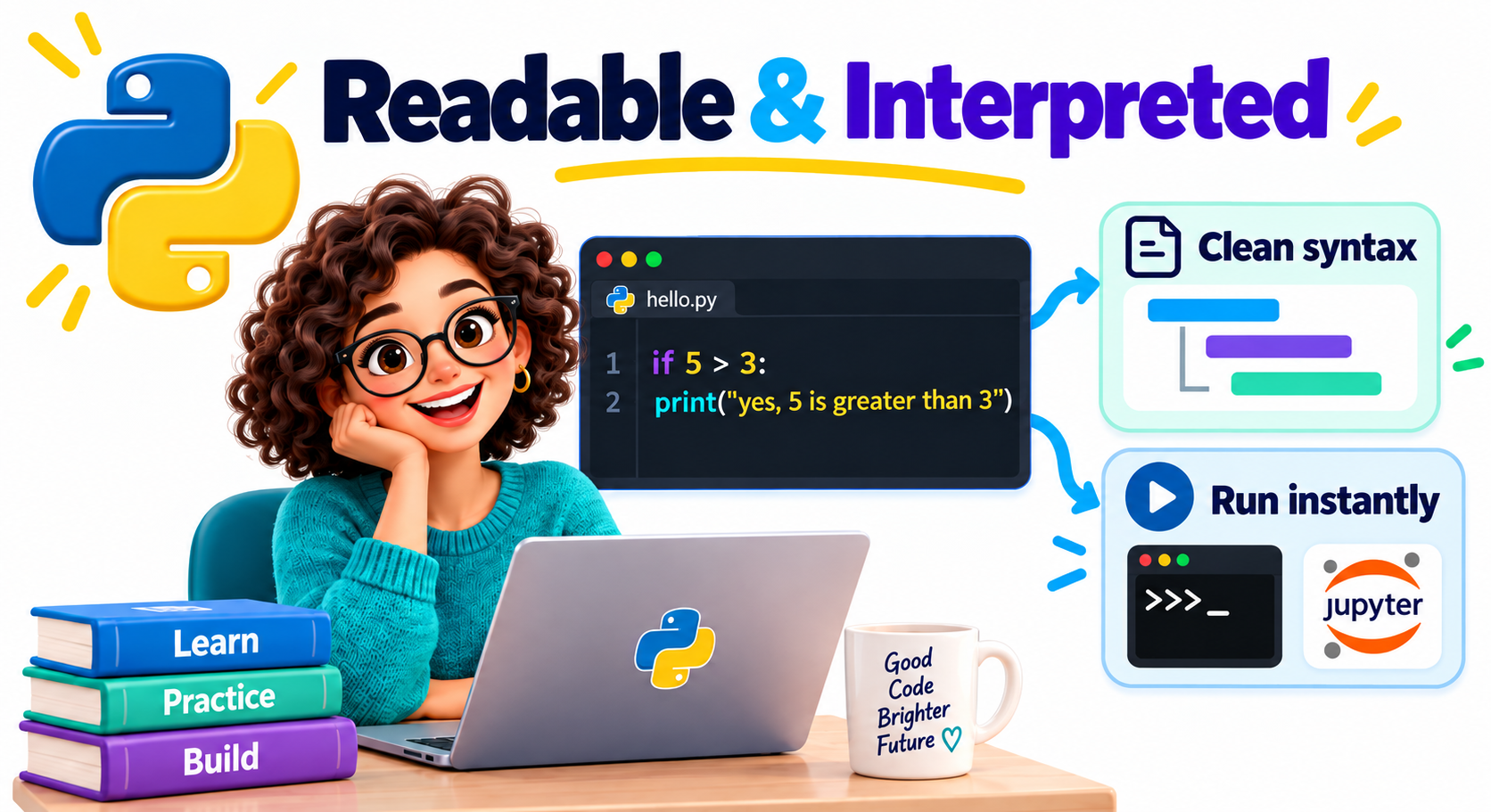

Key Features of Python

1. Readable Syntax

          If 5 > 3:
            print("yes, 5 is greater than 3")

  • Python uses indentation instead of curly braces {} or semicolons; .
  • Code looks clean and organized, which reduces bugs and makes collaboration easier.

2. Interpreted Language

  • You don’t need to compile Python code into machine language before running it.
  • You can run code line-by-line in an interactive shell (REPL) or Jupyter Notebook, making it great for experimentation.

3. Cross-Platform

  • Python works on Windows, macOS, Linux, and even mobile/embedded systems (via MicroPython).

4. Versatile

  • Python supports multiple paradigms:
  • Procedural programming (step-by-step code)
  • Object-oriented programming (classes and objects)
  • Functional programming (lambdas, higher-order functions, map/filter/reduce)

5. Extensive Libraries & Frameworks

  • Python has a massive ecosystem: from Flask/FastAPI for web apps, to Pandas/Numpy for data, to TensorFlow/PyTorch for AI/ML.

Hello World 
The classic beginner’s program in Python:

print("Hello, Python!")

Explanation:

  • print() is a built-in function.
  • It sends the output to the console.
  • This one line shows the simplicity of Python compared to other languages (e.g., in Java you’d need several lines for the same thing).
Sign up or sign in to rate this section
SECTION 2 WHY LEARN PYTHON?

16 min read


Why Python is Important

snake Why Python is Important

Python isn’t just popular...

It’s actually one of the most important skills in the tech industry today.

Let’s see why ✨

Big Idealight bulb

Python is easy to begin with, but powerful enough to stay with you for a long time.

Python at a Glance
beginner_to_expert = True
Easy Quick to learn
Popular High demand
Flexible Many uses
Future Long-term value
man technologist The Main Reasons

notebook with decorative cover

1. Easy to Learn, Hard to Outgrow

Python is very easy to start with.

The syntax is clean, so beginners can understand it quickly.

But here’s the interesting part:

The same Python is used by experts to build AI systems, enterprise applications, and cloud services.

 You start simple... but you can go very far with it.

rocket

2. Demand in the Job Market

Python is always one of the top programming languages.

Companies — from startups to big tech — are actively hiring Python developers.

 Learning Python means more opportunities in the future.

puzzle piece

3. Wide Range of Applications

Python is used in many areas.

globe showing Europe-Africa

4. Community & Ecosystem

Python has a very large community.

So when you get stuck...

 someone has already solved that problem.

There are also many ready-made libraries, so you don’t have to build everything from scratch.

check mark button

5. Future-Proof Skill

Technologies like AI, Machine Learning, cloud, and data engineering depend heavily on Python.

 Learning Python helps you stay relevant as technology grows.

laptop Wide Range of Applications

Web Development

Django
Flask
FastAPI

Python is used to build websites, APIs, and web applications.

Data Science & Machine Learning

Pandas
NumPy
TensorFlow
PyTorch

Python is one of the most important languages in data and AI.

Cloud & DevOps

Boto3
Azure SDK
Automation Tools

Python helps with cloud services, scripts, and infrastructure tasks.

Cybersecurity

Scripts
Testing Tools

Python is useful for automation, testing, and security-related workflows.

Automation

Time Saving
Less Manual Work

Python can reduce repetitive work and save a lot of time.

Game Development

Pygame

Python can also be used to create simple games and fun projects.

 One language... many things you can build.
hundred pointsFinal Thought
1

Python is beginner-friendly, but it also grows with you as your skills become stronger.

2

Because Python is used in many important technologies, learning it is a smart long-term choice.

left speech bubble
Smart Takeaway

Python is easy when you begin... and powerful enough to stay with you for a long time.


3 min read

Python isn’t just popular —
it’s one of the most important skills in the tech industry today. Here’s why:

1. Easy to Learn, Hard to Outgrow

  • The clean syntax allows beginners to learn quickly.
  • But Python is also powerful enough for experts to build AI systems, enterprise apps, and cloud services.

2. Demand in the Job Market

  • Python consistently ranks in the Top 3 most popular programming languages (TIOBE Index, StackOverflow surveys).
  • Employers across industries from startups to FAANG companies actively hire Python developers.

3. Wide Range of Applications

  • Web Development → Frameworks like Django, Flask, FastAPI.
  • Data Science & Machine Learning → Pandas, NumPy, TensorFlow, PyTorch.
  • Cloud & DevOps Automation → Boto3 (AWS), Azure SDK, Ansible, scripting.
  • Cybersecurity → Automation scripts, penetration testing tools.
  • Automation → Write scripts to save time and replace manual tasks.
  • Game Development → Pygame and prototyping libraries.

4. Community & Ecosystem

  • Python has one of the largest developer communities in the world.
  • For almost every problem, there’s already a library or open-source package available.
  • Massive support via forums, StackOverflow, GitHub, and conferences like PyCon.

5. Future-Proof Skill

  • Many cutting-edge technologies (AI, ML, cloud, data engineering) rely heavily on Python.
  • Learning Python ensures you stay relevant in a rapidly evolving job market.
Sign up or sign in to rate this section
SECTION 3 CAREER PATHS

18 min read


Where Can Python Take You?

Where Can Python Take You?

Learning Python today can open doors to many exciting roles.

Let’s see where it can take you ✨

Big Idea

Python is not just one skill for one job. It can lead to many different career paths.

Career Snapshot
one_skill -> many_paths
Backend APIs & apps
Data Pipelines & insights
AI Models & systems
Cloud Automation & DevOps
Different Career Paths
laptop
Backend Developer
Build APIs, cloud apps, and scalable systems using FastAPI or Django.
toolbox
Data Engineer
Work with pipelines using PySpark, Databricks, SQL, and ETL workflows.
robot
AI / ML Engineer
Build and deploy models using TensorFlow, PyTorch, and Scikit-learn.
scientist
Data Scientist
Analyze and visualize data using Pandas, NumPy, and Matplotlib.
☁️
Automation / Cloud Engineer
Use Python for DevOps, CI/CD, scripting, and cloud tools.
One skill... many career options.
✨ Python in the AI Era

You might be thinking...

“If AI can write code... do I still need Python?” thinking face

Let’s understand this backhand index pointing down

1

AI can generate code... but only humans can check if it is correct.

2

Only humans can make sure the code is secure and safe for real-world use.

3

Only humans can improve the code and choose the best approach for the problem.

Without Python knowledge...

You won’t know if the AI-generated code is actually usable.

rocket What Still Matters Even with AI?
✓

Coding is not just about writing syntax.

✓

It’s about solving problems.

✓

It’s about making design decisions.

✓

It’s about choosing the best approach.

Main Point

 These skills still matter, even with AI.

raising hands Python and AI Go Together

Most AI and ML tools like PyTorch, TensorFlow, and Scikit-learn are built using Python.

So if you want to build or work with AI...

PyTorch
Deep learning and model building
TensorFlow
Machine learning and AI systems
Scikit-learn
Classical machine learning workflows
 Python becomes essential.
Final Thought
1

AI can help you write code faster, but you still need Python knowledge to understand what that code is doing.

2

Python gives you both career flexibility and the ability to work with modern technologies like AI, cloud, and data.

sparkles
Smart Takeaway

AI can help you write code... but Python helps you understand and control it.

```


2 min read

Being Skilled in Python today positions you for a wide range of high-demand roles:

  • Backend Developer → Build APIs, cloud apps, and scalable systems with FastAPI/Django.
  • Data Engineer → Design pipelines with PySpark, Databricks, SQL, and ETL workflows.
  • AI / ML Engineer → Develop and deploy models using TensorFlow, PyTorch, Scikit-learn.
  • Data Scientist → Analyze and visualize data with Pandas, NumPy, Matplotlib.
  • Automation / Cloud Engineer → Apply Python for DevOps, CI/CD, scripting, and cloud SDKs.

Python in the AI Era?
AI can generate code, but only the human mind can ensure it’s correct, secure, and efficient for real-world systems.
Without Python knowledge, you cannot validate whether AI-generated code is usable in actual projects.

Coding is more than writing syntax --
it’s about problem-solving, design decisions, and trade-offs.

  • These skills remain essential, even with AI assistance.
  • Most modern AI/ML frameworks (PyTorch, TensorFlow, Scikit-learn) are built on Python.
  • To build, fine-tune, or guide AI systems effectively, Python is indispensable.
Sign up or sign in to rate this section

📝 Assignment

Available Assignments
Assignment Pass Mark Duration Actions
Introduction to Python & Career Paths
70% 01:00:00

📊 Exam

Available Exams
Exam Pass Mark Duration Questions Actions
Introduction to Python & Career Paths
70% 00:30:00 2

💬 Comments & Discussion

Sign up free or sign in to post a comment
Sign up free or sign in
No comments yet

Be the first to share your thoughts!