Current Level 0: Python Level - 0
0 / 6 Miles
0 / 6 Assignments
0 / 6 Exams

Mile 0: Welcome to Vaanii & Python Syllabus Roadmap

🎬 YouTube Videos

No YouTube videos available

Check back later for new YouTube content.

📹 Library Videos

Python Mile #0: Welcome to Vaanii: Library Video

📚 Content

SECTION 1 WELCOME TO VAANII YOUR PYTHON LEARNING JOURNEY BEGINS HERE

29 min read


About Vaanii

Vaanii is an EdTech platform built for students and job seekers who want to build strong careers in Data Engineering, Backend Development, Cloud/DevOps, and modern tech roles.

Unlike traditional courses that focus only on theory, Vaanii focuses on practical learning and real-world implementation.

At Vaanii, we do not believe in memorizing random syntax, watching endless tutorials, or learning things you will never use.

Instead, you learn by actually building things.
What Makes Vaanii Different
Real Learning.
Not Just Theory.
Vaanii is designed to help you move from confusion to confidence by learning through practice, projects, and real engineering thinking.
Project-First Career-Focused Practical Learning
What We Do Not Believe In
Memorizing random syntax

Learning should help you understand how code works, not just repeat lines without context.

Watching 40 hours of tutorials

Passive content alone does not build confidence. You need practice that makes the ideas stick.

Learning things you will never use

The focus stays on skills that matter in real roles, real projects, and real problem solving.

Pretend coding

You learn by doing the work yourself, not by only watching someone else type fast on screen.

Instead, you learn by actually building things.
Start Learning Python the Right Way
01

Even if you have never coded before, the program is designed to make learning simple and practical.

02

Even if programming feels confusing, you will move step by step with clear guidance.

03

Even if you think coding is not for you, the approach is beginner-friendly and easy to follow.

No unnecessary complexity.

No pretend coding.

Just real understanding, step by step.

What You Will Actually Learn
Python fundamentals

Learn the building blocks you need before moving into bigger projects.

Variables, loops, conditions, and functions

Understand the core concepts that appear in almost every Python program.

Problem solving techniques

Build the habit of thinking clearly and solving problems step by step.

Debugging without panic

Learn how to handle errors calmly and keep moving forward.

You will write real code yourself, not just watch someone else type fast on YouTube.
Then Things Get Interesting
01

Backend development becomes easier to understand once your basics are strong.

02

You will start seeing how APIs and web applications are actually built.

03

You will explore databases, automation, and data engineering workflows used in real companies.

Once your basics become strong, Python starts making sense in real tech roles.

What You Will Gain

You will have practical coding experience.

You will understand how real applications work.

You will feel more confident solving problems.

You will be prepared to continue into advanced development paths.

Real progress comes from understanding the basics deeply and using them to build things that matter.

2 min read
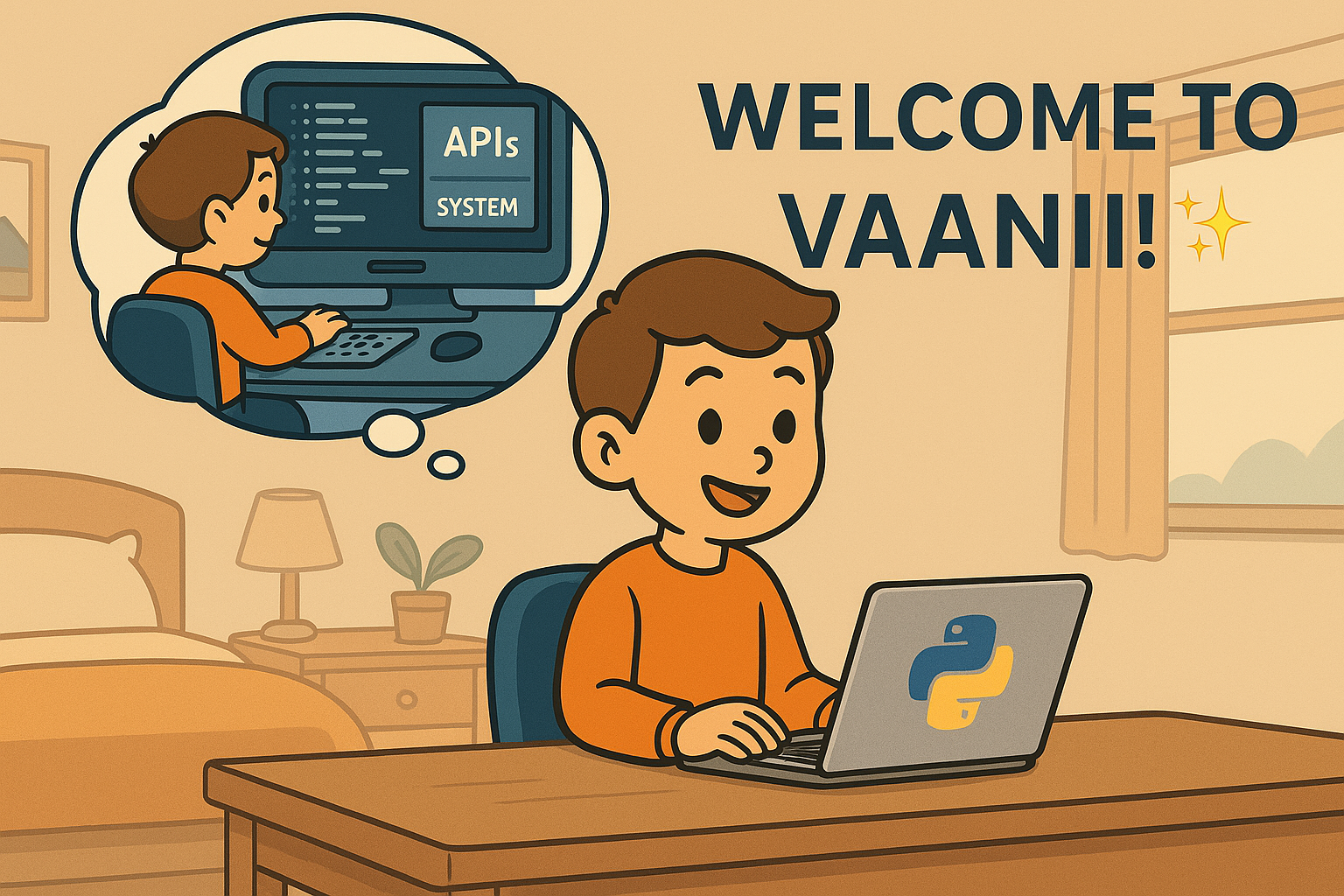
Vaanii is an EdTech platform for candidates and job seekers who want to build strong careers in Data, Backend, Cloud/DevOps Engineering, and beyond.

At Vaanii, our goal is not just to teach theory, but to give you practical, real-world skills through hands-on projects that employers truly value.

By joining the Python program at Vaanii, you don’t just learn syntax. You will:

Build real-time APIs and web applications

Work with databases and data pipelines

Learn logging, debugging, deployment, and scaling

Practice in production-like scenarios tied to backend, data, and cloud engineering roles

By the end of this Python course, you’ll have projects to showcase on your resume and the confidence to perform well in technical interviews.

Sign up or sign in to rate this section
SECTION 2 ABSOLUTE BEGINNER/PROGRAMMING FOUNDATIONS

23 min read


Level 1 : Your Python Journey

goal Goal

Build a strong foundation in Python programming.

This is where you start from scratch...

sparkles and move step by step until you can write working programs confidently sparkles

How to Think About It

Think of each Mile as one real step forward. This level is designed to take you from zero to a strong beginner foundation in a smooth and structured way.

Level 1 Snapshot
From first steps to structured Python thinking.
You begin with the basics, build logic and confidence, then move into functions, debugging, file handling, cleaner code, and real project thinking.
70 Miles 2 End Projects Git + Tools
map Miles in Level 1
Getting Started
Mile 0 Welcome to Vaanii & Python Syllabus Roadmap
Mile 1 Introduction to Python & Career Paths
Mile 2 Setting Up Google Colab / Jupyter Notebook
Mile 3 Writing Your First print() Program (basics of output)
Mile 4 Comments and Docstrings (#, """)
Mile 5 Using input() for User Interaction
Core Basics
Mile 6 Escape Sequences (\n, \t, etc.)
Mile 7 Python Keywords Overview (why they can't be variable                           names)
Mile 8 What Are Variables
Mile 9 Variable Naming Rules & Conventions
Mile 10 Assignments & Dynamic Typing
Mile 11 Multiple & Chain Assignments
Mile 12 Type Reassignment in Variables
Data Types
Mile 13 Introduction to Python Data Types
Mile 14 Numeric Data Types (int, float, brief complex)
Mile 15 Strings (Basics)
Mile 16 Sequence Data Types (list, tuple, range)
Mile 17 Indexing & Slicing (Strings, Lists, Tuples)
Mile 18 Mapping Data Type (Dictionary)
Mile 19 Set Data Type
Mile 20 Boolean Data Type
Mile 21 None Data Type
Mile 22 Binary Data Types (bytes, bytearray)
Operators & Core Functions
Mile 23 Type Conversion & Casting
Mile 24 Arithmetic Operators
Mile 25 Assignment Operators
Mile 26 Comparison Operators
Mile 27 Logical Operators
Mile 28 Identity Operators
Mile 29 Membership Operators
Mile 30 Operator Precedence & Parentheses
Mile 31 Essential Built-in Functions (len(), range(), sum(), etc.)
Mile 32 Type Checking (type(), isinstance())
Logic Building
Mile 33 Conditional Statements (if, elif, else)
Mile 34 Introduction to Loops
Mile 35 Loops: for
Mile 36 Loops: while
Mile 37 Loops: while True
Mile 38 Loop Controls (break, continue, pass)
Mile 39 Using enumerate() and zip()
Mile 40 When to Choose for vs while
Functions & Modules
Mile 41 Functions I (Defining & Calling)
Mile 42 Functions II (Parameters & Return Values)
Mile 43 Modules & Imports (Basics)
Working with Data Methods
Mile 44 Introduction to Data Type Methods
Mile 45 String Methods
Mile 46 List Basics & List Methods
Mile 47 Integer Methods
Mile 48 Float Methods
Mile 49 Complex Number Methods (optional)
Mile 50 Boolean Methods
Mile 51 Dictionary Methods
Mile 52 Set Methods and Operations
Deep Understanding
Mile 53 Data Structures I: Intro to Python Data Structures
Mile 54 Data Structures II: Mutability & Indexing Recap
Mile 55 Shared References in Mutable Objects (Pitfalls & Fixes)
Mile 56 Understanding Memory IDs (id()) and References
Mile 57 Data Structures III: Choosing the Right Data Structure
Errors & Debugging
Mile 58 Introduction to Errors in Python
Mile 59 Common Types of Errors
Mile 60 Reading and Understanding Tracebacks
Mile 61 Exception Handling (try/except/else/finally/raise)
Mile 62 What Is a Bug & What Is Debugging
Formatting & Files
Mile 63 Formatting Text & Numbers (precision, alignment)
Mile 64 Old-Style Formatting with %
Mile 65 Text Alignment and Padding
Mile 66 Basic File Handling (open, read, write)
Writing Better Code
Mile 67 The Zen of Python (PEP 20)
Mile 68 Understanding & Applying Zen Principles
Mile 69 Writing Clean & Pythonic Code (PEP 8)
Mile 70 Reflecting on Your Python Journey
lightning Tools You'll Use
Google Jupyter Notebook
Browser-based environment, like Colab, for learning and experimenting.
VSCode
Coding, debugging, extensions, and a professional workflow.
Git & GitHub
Version control and collaboration from early in your journey.
Python (venv)
Managing dependencies and keeping projects clean and isolated.
trophy Outcome of Level 1
01

You'll understand Python fundamentals like variables, loops, functions, and structures.

02

You'll write simple but structured programs.

03

You'll use Git/GitHub to manage your code.

04

You'll be ready for intermediate Python and data-related work.

End Projects

Menu-based To-Do Application

Number & Text Utility CLI Tool

You're not just learning topics...

rocket You're progressing Mile by Mile toward becoming a Python developer sparkles


7 min read

Goal:

Build a strong foundation in Python programming.
This level is where you start from scratch and learn the core building blocks of Python.

Each Mile introduces a new skill, and by the end, you’ll be able to write working programs confidently.

Miles in Level 1

  • Mile 0 → Welcome to Vaanii & Python Syllabus Roadmap
  • Mile 1 → Introduction to Python & Career Paths
  • Mile 2 → Setting Up Google Colab / Jupyter Notebook
  • Mile 3 → Writing Your First `print()` Program (basics of output)
  • Mile 4 → Comments and Docstrings (#, `"""`)
  • Mile 5 → Using `input()` for User Interaction
  • Mile 6 → Escape Sequences (`\\\\n`, `\\\\t`, etc.)
  • Mile 7 → Python Keywords Overview (why they can’t be variable names)
  • Mile 8 → What Are Variables
  • Mile 9 → Variable Naming Rules & Conventions
  • Mile 10 → Assignments & Dynamic Typing
  • Mile 11 → Multiple & Chain Assignments
  • Mile 12 → Type Reassignment in Variables
  • Mile 13 → Introduction to Python Data Types
  • Mile 14 → Numeric Data Types (int, float, brief complex)
  • Mile 15 → Strings (Basics)
  • Mile 16 → Sequence Data Types (list, tuple, range)
  • Mile 17 → Indexing & Slicing (Strings, Lists, Tuples)
  • Mile 18 → Mapping Data Type (Dictionary)
  • Mile 19 → Set Data Type
  • Mile 20 → Boolean Data Type
  • Mile 21 → None Data Type
  • Mile 22 → Binary Data Types (bytes, bytearray)
  • Mile 23 → Type Conversion & Casting
  • Mile 24 → Arithmetic Operators
  • Mile 25 → Assignment Operators
  • Mile 26 → Comparison Operators
  • Mile 27 → Logical Operators
  • Mile 28 → Identity Operators
  • Mile 29 → Membership Operators
  • Mile 30 → Operator Precedence & Parentheses
  • Mile 31 → Essential Built-in Functions (len(), range(), sum(), etc.)
  • Mile 32 → Type Checking (`type()`, `isinstance()`)
  • Mile 33 → Conditional Statements (if, elif, else)
  • Mile 34 → Introduction to Loops
  • Mile 35 → Loops: **for**
  • Mile 36 → Loops: **while**
  • Mile 37 → Loops: **while True**
  • Mile 38 → Loop Controls (break, continue, pass)
  • Mile 39 → Using `enumerate()` and `zip()`
  • Mile 40 → When to Choose **for** vs **while**
  • Mile 41 → Functions I (Defining & Calling)
  • Mile 42 → Functions II (Parameters & Return Values)
  • Mile 43 → Modules & Imports (Basics)
  • Mile 44 → Introduction to Data Type Methods
  • Mile 45 → String Methods
  • Mile 46 → List Basics & List Methods
  • Mile 47 → Integer Methods
  • Mile 48 → Float Methods
  • Mile 49 → Complex Number Methods (optional)
  • Mile 50 → Boolean Methods
  • Mile 51 → Dictionary Methods
  • Mile 52 → Set Methods and Operations
  • Mile 53 → Data Structures I: Intro to Python Data Structures
  • Mile 54 → Data Structures II: Mutability & Indexing Recap
  • Mile 55 → Shared References in Mutable Objects (Pitfalls & Fixes)
  • Mile 56 → Understanding Memory IDs (`id()`) and References
  • Mile 57 → Data Structures III: Choosing the Right Data Structure
  • Mile 58 → Introduction to Errors in Python
  • Mile 59 → Common Types of Errors
  • Mile 60 → Reading and Understanding Tracebacks
  • Mile 61 → Exception Handling (try/except/else/finally/raise)
  • Mile 62 → What Is a Bug & What Is Debugging
  • Mile 63 → Formatting Text & Numbers (precision, alignment)
  • Mile 64 → Old-Style Formatting with `%`
  • Mile 65 → Text Alignment and Padding
  • Mile 66 → Basic File Handling (open, read, write)
  • Mile 67 → The Zen of Python (PEP 20)
  • Mile 68 → Understanding & Applying Zen Principles
  • Mile 69 → Writing Clean & Pythonic Code (PEP 8)
  • Mile 70 → Reflecting on Your Python Journey

Tools You’ll Use

  • Google Jupyter Notebook → browser-based Jupyter environment (e.g., Google Colab) for writing and running Python notebooks.
  • VSCode → main editor for coding, debugging, extensions and project management.
  • Git & GitHub → version control and collaboration.
  • Python (venv) → virtual environments to manage dependencies.

Outcome of Level 1

By completing Level 1, you will:

  • Understand Python fundamentals (variables, loops, functions, structures).
  • Write simple but structured programs.
  • Use Git/GitHub to manage your code.
  • Be ready to move into data handling and intermediate Python.

End Projects:

Menu-based To-Do Application (in memory) using lists/dicts, loops, conditionals, and functions.
Number & Text Utility CLI Tool that performs arithmetic, comparisons, formatting, and basic text processing using operators and string/number methods.

Sign up or sign in to rate this section
SECTION 3 INTERMEDIATE PYTHON + DATA HANDLING AND PACKAGING

27 min read


Level 2: From Basics to Real-World Python

Goal

Move beyond the basics and learn how Python is used to handle real-world data, write modular code, and package your work into reusable tools.

This level bridges the gap between simple scripts and professional software development.

How This Level Feels

Level 1 was about learning Python.
Level 2 is where things start feeling real.

You'll write better code
Handle real data
Think like a developer

Level 2 Snapshot
From Python learner to problem-solving developer.
This level introduces deeper software design, testing, configuration, packaging, concurrency, and the kind of Python work used in real projects.
Mile 71–177 4 End Projects Real-World Focus
Miles in Level 2
Object-Oriented Programming (OOP)
Mile 71 Advanced Environment Setup – Python, VS Code &                                   Virtual Environments
Mile 72 What Is OOP and Why We Use It
Mile 73 Class Definition Syntax
Mile 74 Creating Objects (Instances)
Mile 75 Instance Attributes
Mile 76 Instance Methods and self
Mile 77 Class Attributes (Shared Data)
Mile 78 Constructors (init)
Mile 79 Object Initialization + @dataclass (Modern Python                                     Classes)
Mile 80 Encapsulation – Public, Private and Protected Members
Mile 81 Getters and Setters (Properties)
Mile 82 Inheritance – Reusing Code
Mile 83 Using super() + Constructor Training
Mile 84 Method Overriding
Mile 85 Polymorphism – One Interface, Many Implementations
Mile 86 Abstraction with the abc Module
Mile 87 Multiple Inheritance (Advanced / Optional)
Mile 88 MRO (Method Resolution Order) + Diamond Problem +                               super() chaining
Mile 89 Dunder (Magic) Methods – Introduction
Mile 90 Common Dunder Methods in Action
Mile 91 Composition and Aggregation
OOP Project
Mile 92 Real-World OOP Project – Overview & Design
Mile 93 Building the OOP Mini Project (Part 1)
Mile 94 Building the OOP Mini Project (Part 2)
Mile 95 Completing and Testing the OOP Project
Iterators, Generators & Functional Tools
Mile 96 Iterators I – Understanding Iterables and Iterators
Mile 97 Iterators II – Using iter() and next()
Mile 98 Iterators III – Custom Iterators and StopIteration
Mile 99 Generators I – Introduction and the yield Keyword
Mile 100 Generators II – Generator Expressions
Mile 101 Generators III – Iterators vs Generators and Use Cases
Mile 102 Advanced enumerate() and zip() patterns
Mile 103 map(), filter(), lambda (Practical use)
Mile 104 functools essentials (reduce, partial)
Mile 105 itertools essentials (chain, islice, cycle, product)
Mile 106 Comprehensions Mastery (list/set/dict comprehensions)
Mile 107 Writing more Pythonic code (patterns & refactors)
Mile 108 Mini Project – Iterators/Generators Based Utility
File Handling & Data
Mile 109 File Paths and Directories with os
Mile 110 Using pathlib for Modern File Handling
Mile 111 File Encodings (utf-8, errors handling)
Mile 112 Reading Large Files Efficiently (buffering + generators)
Mile 113 File Exceptions and Safe File Operations + context                                     managers (with)
Mile 114 CSV File Basics (structured data)
Mile 115 Reading CSV Files with csv.reader
Mile 116 Writing CSV Files with csv.writer
Mile 117 Using DictReader and DictWriter
Mile 118 JSON File Basics (nested data)
Mile 119 Reading and Writing JSON Files
Mile 120 Handling Binary Files (images/audio/pdf basics)
Mile 121 Mini Project – CSV/JSON Based Mini App
Mile 122 Enhancing Project – validations + edge cases
Mile 123 Clean I/O separation (logic vs file layer)
Mile 124 Simple Data Pipelines (CSV → JSON)
Mile 125 Designing file-based storage systems
Mile 126 Project Review + Refactoring checkpoint
Advanced Python Tools
Mile 127 Regex Bridge + Why Regex + Basic Patterns (re)
Mile 128 Regex Core Syntax (character sets, quantifiers, anchors)
Mile 129 Searching with re.search(), re.match(), re.fullmatch()
Mile 130 Finding Multiple Occurrences with re.findall()
Mile 131 Regex Groups + Capturing + Named Groups
Mile 132 Replacing and Splitting Text with Regex
Mile 133 Regex Validation (email/phone/password practical)
Mile 134 Date and Time Basics (datetime)
Mile 135 Formatting Dates and Times
Mile 136 Working with Timezones
Mile 137 Math Module Utilities
Mile 138 Statistics Module Basics
Mile 139 Random Number Generation with random
Mile 140 Mini Project – Validator + DateTime Tool
Mile 141 Data Validation with Pydantic (Models & Basics)
Mile 142 Advanced Pydantic Patterns (nested models + strict                                   types)
Testing & Code Quality
Mile 143 Introduction to Testing in Python + Why Testing Matters
Mile 144 Introduction to unittest
Mile 145 Creating Test Cases with unittest
Mile 146 Running Tests in the Terminal
Mile 147 Organizing Test Files and Folders
Mile 148 Introduction to pytest
Mile 149 Writing Tests with pytest
Mile 150 Using Fixtures in pytest
Mile 151 Mocking and Patching
Mile 152 Code Formatting with Black (Auto-formatting + Style                                 Consistency)
Mile 153 Linting with Ruff (Code Quality Rules + Fixing Issues Fast)
Mile 154 Type Hints in Functions and Classes
Mile 155 Static Typing with mypy
Mile 156 Practical Type Checking in Projects
Mile 157 Refactoring and Maintaining Clean Code
Configuration & Environment
Mile 158 Dependency Basics – pip, requirements.txt, and Project                           Isolation
Mile 159 Understanding Environment Variables
Mile 160 Creating and Managing .env Files
Mile 161 Loading Configurations with python-dotenv
Mile 162 Application Configuration Basics
Mile 163 Pydantic Settings (BaseSettings / pydantic-settings)
Mile 164 Secrets Management Best Practices
Mile 165 Environment-Specific Settings
Mile 166 Security Guidelines for Configuration Management
Logging, Monitoring & Performance
Mile 167 Introduction to Logging
Mile 168 Logging Levels and Formatting
Mile 169 Writing Logs to Files
Mile 170 Measuring Execution Time (Timing Your Code)
Mile 171 Tracking Memory Usage
Mile 172 Profiling with cProfile
Concurrency & Async Programming
Mile 173 What Is Concurrency vs Parallelism
Mile 174 Threads, Processes, and Async – Overview
Mile 175 Asyncio – async/await + gather() — Part 1
Mile 176 timeouts/cancellation + error handling — Part 2
Packaging & Distribution
Mile 177 Packaging & Publishing – pyproject.toml + Poetry + PyPI
Tools You'll Use
Python + venv
Virtual environments and cleaner project isolation become more important in this level.
VSCode
You'll use a real development environment for modular code, testing, and debugging.
Git & GitHub
Version control becomes part of real-world workflows as projects get bigger.
Poetry / PyPI
You move toward packaging, dependency management, and publishing reusable tools.
Outcome of Level 2
01

Work with files and structured data like CSV, JSON, and TXT.

02

Write programs using OOP principles and modular design.

03

Apply testing and mocking to improve code reliability.

04

Follow industry standards with type checking, linting, and formatting.

05

Handle concurrency and parallelism in practical Python work.

06

Package and publish your own Python tools.

End Projects

CSV Data Cleaner Script

JSON-to-CSV Converter with CLI

Async File Downloader

CLI tool published to PyPI

Final Thought

Level 2 is where Python starts feeling like professional software work.

You won't just write scripts anymore — you'll build reusable, testable, real-world Python projects.


11 min read

Goal:

Move beyond the basics and learn how Python is used to handle real-world data, write modular code, and package your work into reusable tools.
This level bridges the gap between simple scripts and professional software development.

Miles in Level 2

  • Mile 71 → Advanced Environment Setup – Python, VS Code & Virtual Environments
  • Mile 72 → What Is OOP and Why We Use It
  • Mile 73 → Class Definition Syntax
  • Mile 74 → Creating Objects (Instances)
  • Mile 75 → Instance Attributes
  • Mile 76 → Instance Methods and self
  • Mile 77 → Class Attributes (Shared Data)
  • Mile 78 → Constructors (init)
  • Mile 79 → Object Initialization + @dataclass (Modern Python Classes)
  • Mile 80 → Encapsulation – Public, Private and Protected Members
  • Mile 81 → Getters and Setters (Properties)
  • Mile 82 → Inheritance – Reusing Code
  • Mile 83 → Using super() + Constructor Training
  • Mile 84 → Method Overriding
  • Mile 85 → Polymorphism – One Interface, Many Implementations
  • Mile 86 → Abstraction with the abc Module
  • Mile 87 → Multiple Inheritance (Advanced / Optional)
  • Mile 88 → MRO (Method Resolution Order) + Diamond Problem + super() chaining
  • Mile 89 → Dunder (Magic) Methods – Introduction
  • Mile 90 → Common Dunder Methods in Action
  • Mile 91 → Composition and Aggregation
  • Mile 92 → Real-World OOP Project – Overview & Design
  • Mile 93 → Building the OOP Mini Project (Part 1)
  • Mile 94 → Building the OOP Mini Project (Part 2)
  • Mile 95 → Completing and Testing the OOP Project
  • Mile 96 → Iterators I – Understanding Iterables and Iterators
  • Mile 97 → Iterators II – Using iter() and next()
  • Mile 98 → Iterators III – Custom Iterators and StopIteration
  • Mile 99 → Generators I – Introduction and the yield Keyword
  • Mile 100 → Generators II – Generator Expressions
  • Mile 101 → Generators III – Iterators vs Generators and Use Cases
  • Mile 102 → Advanced enumerate() and zip() patterns
  • Mile 103 → map(), filter(), lambda (Practical use)
  • Mile 104 → functools essentials (reduce, partial)
  • Mile 105 → itertools essentials (chain, islice, cycle, product)
  • Mile 106 → Comprehensions Mastery (list/set/dict comprehensions)
  • Mile 107 → Writing more Pythonic code (patterns & refactors)
  • Mile 108 → Mini Project – Iterators/Generators Based Utility
  • Mile 109 → File Paths and Directories with os
  • Mile 110 → Using pathlib for Modern File Handling
  • Mile 111 → File Encodings (utf-8, errors handling)
  • Mile 112 → Reading Large Files Efficiently (buffering + generators)
  • Mile 113 → File Exceptions and Safe File Operations + context managers (with)
  • Mile 114 → CSV File Basics (structured data)
  • Mile 115 → Reading CSV Files with csv.reader
  • Mile 116 → Writing CSV Files with csv.writer
  • Mile 117 → Using DictReader and DictWriter
  • Mile 118 → JSON File Basics (nested data)
  • Mile 119 → Reading and Writing JSON Files
  • Mile 120 → Handling Binary Files (images/audio/pdf basics)
  • Mile 121 → Mini Project – CSV/JSON Based Mini App
  • Mile 122 → Enhancing Project – validations + edge cases
  • Mile 123 → Clean I/O separation (logic vs file layer)
  • Mile 124 → Simple Data Pipelines (CSV → JSON)
  • Mile 125 → Designing file-based storage systems
  • Mile 126 → Project Review + Refactoring checkpoint
  • Mile 127 → Regex Bridge + Why Regex + Basic Patterns (re)
  • Mile 128 → Regex Core Syntax (character sets, quantifiers, anchors)
  • Mile 129 → Searching with re.search(), re.match(), re.fullmatch()
  • Mile 130 → Finding Multiple Occurrences with re.findall()
  • Mile 131 → Regex Groups + Capturing + Named Groups
  • Mile 132 → Replacing and Splitting Text with Regex
  • Mile 133 → Regex Validation (email/phone/password practical)
  • Mile 134 → Date and Time Basics (datetime)
  • Mile 135 → Formatting Dates and Times
  • Mile 136 → Working with Timezones
  • Mile 137 → Math Module Utilities
  • Mile 138 → Statistics Module Basics
  • Mile 139 → Random Number Generation with random
  • Mile 140 → Mini Project – Validator + DateTime Tool
  • Mile 141 → Data Validation with Pydantic (Models & Basics)
  • Mile 142 → Advanced Pydantic Patterns (nested models + strict types)
  • Mile 143 → Introduction to Testing in Python + Why Testing Matters
  • Mile 144 → Introduction to unittest
  • Mile 145 → Creating Test Cases with unittest
  • Mile 146 → Running Tests in the Terminal
  • Mile 147 → Organizing Test Files and Folders
  • Mile 148 → Introduction to pytest
  • Mile 149 → Writing Tests with pytest
  • Mile 150 → Using Fixtures in pytest
  • Mile 151 → Mocking and Patching
  • Mile 152 → Code Formatting with Black (Auto-formatting + Style Consistency)
  • Mile 153 → Linting with Ruff (Code Quality Rules + Fixing Issues Fast)
  • Mile 154 → Type Hints in Functions and Classes
  • Mile 155 → Static Typing with mypy
  • Mile 156 → Practical Type Checking in Projects
  • Mile 157 → Refactoring and Maintaining Clean Code
  • Mile 158 → Dependency Basics – pip, requirements.txt, and Project Isolation
  • Mile 159 → Understanding Environment Variables
  • Mile 160 → Creating and Managing .env Files
  • Mile 161 → Loading Configurations with python-dotenv
  • Mile 162 → Application Configuration Basics
  • Mile 163 → Pydantic Settings (BaseSettings / pydantic-settings)
  • Mile 164 → Secrets Management Best Practices
  • Mile 165 → Environment-Specific Settings
  • Mile 166 → Security Guidelines for Configuration Management
  • Mile 167 → Introduction to Logging
  • Mile 168 → Logging Levels and Formatting
  • Mile 169 → Writing Logs to Files
  • Mile 170 → Measuring Execution Time (Timing Your Code)
  • Mile 171 → Tracking Memory Usage
  • Mile 172 → Profiling with cProfile
  • Mile 173 → What Is Concurrency vs Parallelism
  • Mile 174 → Threads, Processes, and Async – Overview
  • Mile 175 → Asyncio – async/await + gather() -- Part 1
  • Mile 176 → timeouts/cancellation + error handling -- Part 2
  • Mile 177 → Packaging & Publishing – pyproject.toml + Poetry + PyPI

Outcome of Level 2

By completing Level 2, you will:

  • Work with files and structured data (CSV, JSON, TXT).
  • Write programs using OOP principles.
  • Apply testing and mocking to improve code reliability.
  • Follow industry standards with type checking, linting, and formatting.
  • Handle concurrency & parallelism to make programs efficient.
  • Package and publish your own Python tools.

End Projects:

  • CSV Data Cleaner Script.
  • JSON-to-CSV Converter with CLI.
  • Async File Downloader.
  • A CLI tool published to PyPI.
Sign up or sign in to rate this section
SECTION 4 DATABASES AND BACKEND WITH FASTAPI

23 min read


Level 3: Build Real Backend Systems

goal Goal

Learn to connect Python with databases and build backend systems using FastAPI.

This level takes you from writing scripts...

rocket to building real web APIs that power applications sparkles

What Changes in This Level

Till now, you were writing programs.
Now you'll start building systems:

api APIs
database Databases
gear Real backend logic

Level 3 Snapshot
From Python coder to backend builder.
This level introduces API design, FastAPI, SQL, authentication, deployment, async workflows, and the architecture behind real backend systems.
Mile 178–255 3 End Projects FastAPI + SQL
map Miles in Level 3
Backend & API Fundamentals
Mile 178 Backend Development Overview (How the Web Works +                            Client/Server)
Mile 179 APIs & REST Fundamentals (Architecture + API design                                principles)
Mile 180 HTTP Fundamentals (methods, status codes, headers,                                body)
Mile 181 REST API Best Practices (naming, versioning, pagination,                            filtering)
Mile 182 API Testing Tools (Postman / curl basics + workflows)
Mile 183 Authentication in API Requests (API keys, tokens,                                        headers)
Mile 184 API Error Handling Standards (error responses, retries,                               timeouts)
Building APIs with FastAPI
Mile 185 Introduction to FastAPI (project structure + running                                    server)
Mile 186 Routing + Path Parameters + Query Parameters
Mile 187 Request Body Handling (JSON input + validation)
Mile 188 Response Models & Response Validation
Mile 189 Dependency Injection in FastAPI
Mile 190 Middleware, CORS & Request Lifecycle
Mile 191 OpenAPI + Swagger Docs + Documentation Best                                          Practices
Mile 192 Mini Project: FastAPI CRUD API (basic version)
Databases & SQL
Mile 193 Introduction to Databases (Relational basics + why SQL)
Mile 194 SQLite Setup + Database Design Basics
Mile 195 SQL Data Types + Table Design
Mile 196 SQL CRUD (INSERT, SELECT, UPDATE, DELETE)
Mile 197 SQL Filtering + Sorting + LIMIT
Mile 198 SQL Aggregations (COUNT, SUM, AVG, GROUP BY,                                        HAVING)
Mile 199 SQL Joins (INNER, LEFT, CROSS)
Mile 200 Subqueries + Nested Queries
Mile 201 Constraints + Relationships (PK, FK, UNIQUE, NOT NULL)
Mile 202 Transactions (COMMIT, ROLLBACK) + Data Integrity
Mile 203 SQL Best Practices (normalization basics, indexing                                      concept)
Mile 204 Python Database Connection (sqlite3)
Mile 205 Writing Queries from Python (cursor patterns)
Mile 206 Parameterized Queries + SQL Injection Prevention
Mile 207 Creating a Database Utility Layer (helpers + clean DB                                  functions)
Mile 208 Mini Project Upgrade: FastAPI + SQLite Integration (full                                CRUD)
SQLAlchemy ORM
Mile 209 SQLAlchemy ORM Basics (engine, session, models)
Mile 210 Defining Models + Relationships
Mile 211 CRUD with SQLAlchemy ORM
Mile 212 Migrations with Alembic (workflow level)
Mile 213 Integrating SQLAlchemy with FastAPI (dependency                                    patterns)
Authentication & Security
Mile 214 Authentication vs Authorization
Mile 215 Password Hashing + Security Basics (passlib)
Mile 216 JWT Authentication (access tokens + expiry)
Mile 217 Protecting Routes with Dependencies
Mile 218 Role-Based Access Control (RBAC)
Mile 219 OAuth2 Concepts + Third-party login overview
Mile 220 API Security Best Practices (rate limits, validation,                                      secrets)
Mile 221 Add Authentication into the FastAPI Project (login +                                    protected routes)
Async & Performance
Mile 222 Async Backend Patterns (when async helps + when it                                doesn't)
Mile 223 Async HTTP Clients (httpx / aiohttp)
Mile 224 Async Database Operations with aiosqlite
Mile 225 Background Tasks in FastAPI (BackgroundTasks + task                                patterns)
Mile 226 Performance Benchmarking (sync vs async in APIs)
Deployment & DevOps
Mile 227 Git & GitHub Workflow (repo + commits + PR workflow)
Mile 228 Branching, Merging, Code Reviews
Mile 229 Deployment Readiness (configs, env vars, production                                settings)
Mile 230 Docker Fundamentals (Dockerfile)
Mile 231 Dockerizing FastAPI
Mile 232 Docker Compose (API + DB together)
Mile 233 CI/CD Basics with GitHub Actions
Mile 234 Automated Testing in CI (pytest in pipeline)
Mile 235 Deploying FastAPI (Render / Railway / Fly.io)
Mile 236 Monitoring + Logs in Production (basic ops view)
Production & Advanced Topics
Mile 237 API Versioning + Deprecation Strategy
Mile 238 Rate Limiting + Security in Production
Mile 239 Caching Concepts (Redis overview + why caching)
Mile 240 Using Redis with FastAPI (conceptual + simple usage)
Mile 241 Load Testing Basics (locust / benchmarking mindset)
Mile 242 System Design Basics for Backend APIs (high level)
Mile 243 PostgreSQL Setup (optional upgrade from SQLite)
Mile 244 PostgreSQL with SQLAlchemy + Migrations
Mile 245 Deployment Security (HTTPS, secrets, token safety)
Mile 246 Observability Basics (metrics, traces, error reporting                                  overview)
Mile 247 Documentation + API Developer Experience (DX)
Mile 248 Building a Portfolio-ready Backend API (checklist &                                    standards)
Mile 249 Handling Files in APIs (uploads, storage concepts)
Mile 250 API Pagination + Filtering + Sorting (production style)
Mile 251 Using Background Jobs Properly (queues concept)
Mile 252 Rate Limit + Auth Refresh Tokens (production patterns)
Mile 253 Production Deployment Checklist (end-to-end)
Mile 254 Common API Failures + Debugging in Production
Mile 255 Final Project: Production-Ready Backend System                                        (FastAPI + DB + Auth + Docker + Deploy)
 Outcome of Level 3
01

Understand relational databases and schema design.

02

Write and execute real SQL queries.

03

Connect Python with databases in practical ways.

04

Build REST APIs using FastAPI.

05

Implement authentication and security.

06

Handle real production-level API concepts.

End Projects

memo Employee Database App (FastAPI backend)

memo User Management API (CRUD + JWT Authentication)

memo File Upload API with validation

idea Final Thought

This is where Python starts powering real applications.

rocket You won't just write scripts anymore — you'll build backend systems that connect code, data, and APIs.


9 min read

Goal:

Learn to connect Python with databases and build backend systems using FastAPI.
This level takes you from writing scripts to creating full web APIs that power real applications.

Miles in Level 3

  • Mile 178 → Backend Development Overview (How the Web Works + Client/Server)
  • Mile 179 → APIs & REST Fundamentals (Architecture + API design principles)
  • Mile 180 → HTTP Fundamentals (methods, status codes, headers, body)
  • Mile 181 → REST API Best Practices (naming, versioning, pagination, filtering)
  • Mile 182 → API Testing Tools (Postman / curl basics + workflows)
  • Mile 183 → Authentication in API Requests (API keys, tokens, headers)
  • Mile 184 → API Error Handling Standards (error responses, retries, timeouts)
  • Mile 185 → Introduction to FastAPI (project structure + running server)
  • Mile 186 → Routing + Path Parameters + Query Parameters
  • Mile 187 → Request Body Handling (JSON input + validation)
  • Mile 188 → Response Models & Response Validation
  • Mile 189 → Dependency Injection in FastAPI
  • Mile 190 → Middleware, CORS & Request Lifecycle
  • Mile 191 → OpenAPI + Swagger Docs + Documentation Best Practices
  • Mile 192 → Mini Project: FastAPI CRUD API (basic version)
  • Mile 193 → Introduction to Databases (Relational basics + why SQL)
  • Mile 194 → SQLite Setup + Database Design Basics
  • Mile 195 → SQL Data Types + Table Design
  • Mile 196 → SQL CRUD (INSERT, SELECT, UPDATE, DELETE)
  • Mile 197 → SQL Filtering + Sorting + LIMIT
  • Mile 198 → SQL Aggregations (COUNT, SUM, AVG, GROUP BY, HAVING)
  • Mile 199 → SQL Joins (INNER, LEFT, CROSS)
  • Mile 200 → Subqueries + Nested Queries
  • Mile 201 → Constraints + Relationships (PK, FK, UNIQUE, NOT NULL)
  • Mile 202 → Transactions (COMMIT, ROLLBACK) + Data Integrity
  • Mile 203 → SQL Best Practices (normalization basics, indexing concept)
  • Mile 204 → Python Database Connection (sqlite3)
  • Mile 205 → Writing Queries from Python (cursor patterns)
  • Mile 206 → Parameterized Queries + SQL Injection Prevention
  • Mile 207 → Creating a Database Utility Layer (helpers + clean DB functions)
  • Mile 208 → Mini Project Upgrade: FastAPI + SQLite Integration (full CRUD)
  • Mile 209 → SQLAlchemy ORM Basics (engine, session, models)
  • Mile 210 → Defining Models + Relationships
  • Mile 211 → CRUD with SQLAlchemy ORM
  • Mile 212 → Migrations with Alembic (workflow level)
  • Mile 213 → Integrating SQLAlchemy with FastAPI (dependency patterns)
  • Mile 214 → Authentication vs Authorization
  • Mile 215 → Password Hashing + Security Basics (passlib)
  • Mile 216 → JWT Authentication (access tokens + expiry)
  • Mile 217 → Protecting Routes with Dependencies
  • Mile 218 → Role-Based Access Control (RBAC)
  • Mile 219 → OAuth2 Concepts + Third-party login overview
  • Mile 220 → API Security Best Practices (rate limits, validation, secrets)
  • Mile 221 → Add Authentication into the FastAPI Project (login + protected routes)
  • Mile 222 → Async Backend Patterns (when async helps + when it doesn’t)
  • Mile 223 → Async HTTP Clients (httpx / aiohttp)
  • Mile 224 → Async Database Operations with aiosqlite
  • Mile 225 → Background Tasks in FastAPI (BackgroundTasks + task patterns)
  • Mile 226 → Performance Benchmarking (sync vs async in APIs)
  • Mile 227 → Git & GitHub Workflow (repo + commits + PR workflow)
  • Mile 228 → Branching, Merging, Code Reviews
  • Mile 229 → Deployment Readiness (configs, env vars, production settings)
  • Mile 230 → Docker Fundamentals (Dockerfile)
  • Mile 231 → Dockerizing FastAPI
  • Mile 232 → Docker Compose (API + DB together)
  • Mile 233 → CI/CD Basics with GitHub Actions
  • Mile 234 → Automated Testing in CI (pytest in pipeline)
  • Mile 235 → Deploying FastAPI (Render / Railway / Fly.io)
  • Mile 236 → Monitoring + Logs in Production (basic ops view)
  • Mile 237 → API Versioning + Deprecation Strategy
  • Mile 238 → Rate Limiting + Security in Production
  • Mile 239 → Caching Concepts (Redis overview + why caching)
  • Mile 240 → Using Redis with FastAPI (conceptual + simple usage)
  • Mile 241 → Load Testing Basics (locust / benchmarking mindset)
  • Mile 242 → System Design Basics for Backend APIs (high level)
  • Mile 243 → PostgreSQL Setup (optional upgrade from SQLite)
  • Mile 244 → PostgreSQL with SQLAlchemy + Migrations
  • Mile 245 → Deployment Security (HTTPS, secrets, token safety)
  • Mile 246 → Observability Basics (metrics, traces, error reporting overview)
  • Mile 247 → Documentation + API Developer Experience (DX)
  • Mile 248 → Building a Portfolio-ready Backend API (checklist & standards)
  • Mile 249 → Handling Files in APIs (uploads, storage concepts)
  • Mile 250 → API Pagination + Filtering + Sorting (production style)
  • Mile 251 → Using Background Jobs Properly (queues concept)
  • Mile 252 → Rate Limit + Auth Refresh Tokens (production patterns)
  • Mile 253 → Production Deployment Checklist (end-to-end)
  • Mile 254 → Common API Failures + Debugging in Production
  • Mile 255 → Final Project: Production-Ready Backend System (FastAPI + DB + Auth + Docker + Deploy)

Outcome of Level 3

By completing Level 3, you will:

  • Understand relational databases and how to design schemas.
  • Write and execute SQL queries both manually and from Python.
  • Use SQLAlchemy for database access (sync & async).
  • Design and build REST APIs with FastAPI.
  • Implement authentication, middleware, and security practices.
  • Handle large data & rate limiting in production APIs.

End Projects:

  • Employee Database App with FastAPI backend.
  • User Management API (CRUD + JWT Authentication).
  • File Upload API with validation.
Sign up or sign in to rate this section
SECTION 5 DEPLOYMENT AND CLOUD FOUNDATIONS

25 min read


Level 4: From Code to Cloud

Goal

Learn how to take your Python and FastAPI applications from local development to the cloud, making them production-ready with deployment pipelines, containerization, and monitoring.

This level focuses on DevOps, cloud integration, and automation, the final step to becoming job-ready in backend and data engineering.

What Changes in This Level

Till now, you built applications.
Now you learn how to:

Deploy them
Scale them
Monitor them
Make them production-ready

Level 4 Snapshot
From backend developer to production-ready engineer.
This level is about system design, deployment, observability, security, async workloads, and the real cloud-side responsibilities behind scalable software.
Mile 256–340 3 End Projects Cloud + DevOps
Miles in Level 4
System Design & Architecture
Mile 256 Understanding Backend Architecture (Monolith vs                                      Microservices)
Mile 257 What Are APIs, Services & Layers in a System
Mile 258 Designing Scalable Python Projects (Modular Design)
Mile 259 API Versioning and Structure
Mile 260 Request Lifecycle in FastAPI / Flask
Mile 261 Dependency Injection at Scale
Mile 262 Layered Architecture (Controllers, Services,                                                  Repositories)
Mile 263 Service-Oriented Architecture (SOA) Concepts
Mile 264 Microservices Architecture – Principles and Benefits
Mile 265 Communication Between Microservices (REST, gRPC,                                  Message Queues)
Mile 266 Building a Mini Microservice System in Python
Databases, Caching & Performance
Mile 267 Database Optimization and Indexing
Mile 268 Connection Pooling and ORM Performance Tuning
Mile 269 Transactions and Isolation Levels
Mile 270 Advanced SQL Queries in SQLAlchemy
Mile 271 Data Migrations and Schema Versioning (Alembic Deep                              Dive)
Mile 272 Using Redis for Caching and Queues
Mile 273 Implementing Caching Layers (Query, Response, API                                    Cache)
Mile 274 Asynchronous Databases (Databases + async                                              SQLAlchemy)
Mile 275 Working with Elasticsearch for Searching
Mile 276 Message Brokers (RabbitMQ, Kafka) for Event-Driven                                  Systems
Security & Middleware
Mile 277 Deep Dive into Authentication Flows (Session vs Token)
Mile 278 OAuth2 Advanced Flows
Mile 279 Integrating Google & GitHub Login (Social Auth)
Mile 280 API Key and Token-Based Auth
Mile 281 Role-Based Access Control (RBAC) Design
Mile 282 Implementing Middleware in FastAPI
Mile 283 Global Error & Exception Handling Middleware
Mile 284 Logging Middleware for Request/Response Tracking
Mile 285 Security Headers and Rate Limiting
Mile 286 Input Sanitization and Validation Best Practices
Async Systems & Real-Time
Mile 287 Advanced Async Concepts (Event Loop Internals)
Mile 288 Async Task Queues (Celery, RQ)
Mile 289 Background Jobs and Scheduled Tasks
Mile 290 Real-Time Systems with WebSockets
Mile 291 Building Live Chat or Notification Service
Mile 292 Async API Performance Testing and Optimization
Mile 293 Using FastAPI BackgroundTasks
Mile 294 Integrating Celery with FastAPI
Cloud, Docker & Kubernetes
Mile 295 Introduction to Cloud Deployment (AWS, Azure, GCP)
Mile 296 Understanding Docker at a Deeper Level
Mile 297 Docker Compose for Multi-Service Apps
Mile 298 Using Environment Variables in Docker Containers
Mile 299 Container Networking and Volumes
Mile 300 Kubernetes Basics (Pods, Services, Deployments)
Mile 301 Creating a Kubernetes Deployment for a Python API
Mile 302 Kubernetes Secrets, ConfigMaps & Scaling
CI/CD & Deployment
Mile 303 CI/CD Pipelines with GitHub Actions
Mile 304 Automated Testing and Deployment
Mile 305 Dockerizing Databases and Message Brokers
Mile 306 Deploying FastAPI + PostgreSQL + Redis Stack
Mile 307 Monitoring Docker Containers with Prometheus &                                      Grafana
Monitoring & Observability
Mile 308 Structured Logging and JSON Logs
Mile 309 Logging to External Services (Logstash, Loki)
Mile 310 Metrics, Tracing & Observability Concepts
Mile 311 Using OpenTelemetry with FastAPI
Mile 312 Performance Profiling in Production
Mile 313 Creating Dashboards with Grafana
Mile 314 Health Checks and System Status Endpoints
Mile 315 Building an Internal Monitoring Service
Testing at Scale
Mile 316 Integration Testing in FastAPI
Mile 317 Mocking Databases and External APIs
Mile 318 Load Testing with locust & k6
Mile 319 Continuous Testing in CI/CD Pipelines
Mile 320 Test Coverage and Reports
Mile 321 Behavior-Driven Testing (BDD) with pytest-bdd
Mile 322 Property-Based Testing (hypothesis)
Final System Build
Mile 323 Designing a Full Scalable API System (Architecture Plan)
Mile 324 Implementing Multi-Service Backend (Users, Tasks, Auth)
Mile 325 Service Communication via Message Broker
Mile 326 Implementing API Gateway and Load Balancer
Mile 327 Distributed Logging and Centralized Config
Mile 328 Deploying Full Stack on Cloud (Render / AWS ECS)
Mile 329 Adding CI/CD and Monitoring
Mile 330 Documentation with Swagger, Redoc & Markdown Docs
Mile 331 Project Review and Optimization
Mile 332 Versioning, Releases, and Changelogs
Mile 333 Packaging the Final Project for Production
Automation & Real Use Cases
Mile 334 Automating Scripts and Reports with Python
Mile 335 Scheduling Python Tasks with cron and APScheduler
Mile 336 Building Command Line Tools with argparse and click
Mile 337 Integrating External APIs (Slack, Gmail, Twilio, Notion)
Mile 338 Automating File Operations (Excel, PDFs, etc.)
Mile 339 Building Small Automation Projects
Mile 340 Preparing for Python Developer Interviews & Portfolio                                Building
Outcome of Level 4
01

Deploy Python & FastAPI applications to the cloud.

02

Secure applications using environment variables and secrets.

03

Build CI/CD pipelines and production workflows.

04

Monitor applications with real tools.

05

Deliver production-ready backend systems.

End Projects

memo FastAPI + Cloud Database + Storage Deployment Pipeline

memo Data Ingestion Tool

memo Cloud-Hosted API with CI/CD

Final Journey Complete

Now you've completed:

Level 1 → Foundations

Level 2 → Intermediate & Data

Level 3 → Backend & Databases

Level 4 → Cloud & Deployment


10 min read

Goal:

Learn how to take your Python and FastAPI applications from local development to the cloud, making them production-ready with deployment pipelines, containerization, and monitoring.

This level focuses on DevOps, cloud integration, and automation -- 
the final step to becoming job-ready in backend and data engineering.


Miles in Level 4

  • Mile 256 → Understanding Backend Architecture (Monolith vs Microservices)
  • Mile 257 → What Are APIs, Services & Layers in a System
  • Mile 258 → Designing Scalable Python Projects (Modular Design)
  • Mile 259 → API Versioning and Structure
  • Mile 260 → Request Lifecycle in FastAPI / Flask
  • Mile 261 → Dependency Injection at Scale
  • Mile 262 → Layered Architecture (Controllers, Services, Repositories)
  • Mile 263 → Service-Oriented Architecture (SOA) Concepts
  • Mile 264 → Microservices Architecture – Principles and Benefits
  • Mile 265 → Communication Between Microservices (REST, gRPC, Message Queues)
  • Mile 266 → Building a Mini Microservice System in Python
  • Mile 267 → Database Optimization and Indexing
  • Mile 268 → Connection Pooling and ORM Performance Tuning
  • Mile 269 → Transactions and Isolation Levels
  • Mile 270 → Advanced SQL Queries in SQLAlchemy
  • Mile 271 → Data Migrations and Schema Versioning (Alembic Deep Dive)
  • Mile 272 → Using Redis for Caching and Queues
  • Mile 273 → Implementing Caching Layers (Query, Response, API Cache)
  • Mile 274 → Asynchronous Databases (Databases + async SQLAlchemy)
  • Mile 275 → Working with Elasticsearch for Searching
  • Mile 276 → Message Brokers (RabbitMQ, Kafka) for Event-Driven Systems
  • Mile 277 → Deep Dive into Authentication Flows (Session vs Token)
  • Mile 278 → OAuth2 Advanced Flows
  • Mile 279 → Integrating Google & GitHub Login (Social Auth)
  • Mile 280 → API Key and Token-Based Auth
  • Mile 281 → Role-Based Access Control (RBAC) Design
  • Mile 282 → Implementing Middleware in FastAPI
  • Mile 283 → Global Error & Exception Handling Middleware
  • Mile 284 → Logging Middleware for Request/Response Tracking
  • Mile 285 → Security Headers and Rate Limiting
  • Mile 286 → Input Sanitization and Validation Best Practices
  • Mile 287 → Advanced Async Concepts (Event Loop Internals)
  • Mile 288 → Async Task Queues (Celery, RQ)
  • Mile 289 → Background Jobs and Scheduled Tasks
  • Mile 290 → Real-Time Systems with WebSockets
  • Mile 291 → Building Live Chat or Notification Service
  • Mile 292 → Async API Performance Testing and Optimization
  • Mile 293 → Using FastAPI BackgroundTasks
  • Mile 294 → Integrating Celery with FastAPI
  • Mile 295 → Introduction to Cloud Deployment (AWS, Azure, GCP)
  • Mile 296 → Understanding Docker at a Deeper Level
  • Mile 297 → Docker Compose for Multi-Service Apps
  • Mile 298 → Using Environment Variables in Docker Containers
  • Mile 299 → Container Networking and Volumes
  • Mile 300 → Kubernetes Basics (Pods, Services, Deployments)
  • Mile 301 → Creating a Kubernetes Deployment for a Python API
  • Mile 302 → Kubernetes Secrets, ConfigMaps & Scaling
  • Mile 303 → CI/CD Pipelines with GitHub Actions
  • Mile 304 → Automated Testing and Deployment
  • Mile 305 → Dockerizing Databases and Message Brokers
  • Mile 306 → Deploying FastAPI + PostgreSQL + Redis Stack
  • Mile 307 → Monitoring Docker Containers with Prometheus & Grafana
  • Mile 308 → Structured Logging and JSON Logs
  • Mile 309 → Logging to External Services (Logstash, Loki)
  • Mile 310 → Metrics, Tracing & Observability Concepts
  • Mile 311 → Using OpenTelemetry with FastAPI
  • Mile 312 → Performance Profiling in Production
  • Mile 313 → Creating Dashboards with Grafana
  • Mile 314 → Health Checks and System Status Endpoints
  • Mile 315 → Building an Internal Monitoring Service
  • Mile 316 → Integration Testing in FastAPI
  • Mile 317 → Mocking Databases and External APIs
  • Mile 318 → Load Testing with locust & k6
  • Mile 319 → Continuous Testing in CI/CD Pipelines
  • Mile 320 → Test Coverage and Reports
  • Mile 321 → Behavior-Driven Testing (BDD) with pytest-bdd
  • Mile 322 → Property-Based Testing (hypothesis)
  • Mile 323 → Designing a Full Scalable API System (Architecture Plan)
  • Mile 324 → Implementing Multi-Service Backend (Users, Tasks, Auth)
  • Mile 325 → Service Communication via Message Broker
  • Mile 326 → Implementing API Gateway and Load Balancer
  • Mile 327 → Distributed Logging and Centralized Config
  • Mile 328 → Deploying Full Stack on Cloud (Render / AWS ECS)
  • Mile 329 → Adding CI/CD and Monitoring
  • Mile 330 → Documentation with Swagger, Redoc & Markdown Docs
  • Mile 331 → Project Review and Optimization
  • Mile 332 → Versioning, Releases, and Changelogs
  • Mile 333 → Packaging the Final Project for Production
  • Mile 334 → Automating Scripts and Reports with Python
  • Mile 335 → Scheduling Python Tasks with cron and APScheduler
  • Mile 336 → Building Command Line Tools with argparse and click
  • Mile 337 → Integrating External APIs (Slack, Gmail, Twilio, Notion)
  • Mile 338 → Automating File Operations (Excel, PDFs, etc.)
  • Mile 339 → Building Small Automation Projects
  • Mile 340 → Preparing for Python Developer Interviews & Portfolio Building

Outcome of Level 4

By completing Level 4, you will:

  • Deploy Python and FastAPI applications to the Azure cloud.
  • Secure applications using Key Vault and environment variables.
  • Automate storage and data pipelines with Azure SDKs.
  • Build a CI/CD pipeline using GitHub Actions.
  • Monitor applications with Azure Monitor & App Insights.
  • Deliver a production-ready backend system with real cloud services.

End Projects:

  • FastAPI + Azure Database + Blob Storage Deployment Pipeline.
  • Blob Storage Data Ingestion Tool in Python.
  • Cloud-Hosted API with CI/CD Integration.

With Level 4 complete, you finish the Python Backend & Engineering Journey:

  • Level 1 → Foundations
  • Level 2 → Intermediate & Data Handling
  • Level 3 → Databases & Backend
  • Level 4 → Deployment & Cloud.

By now, you’ll have a portfolio of projects showing everything from CLI apps to cloud-deployed backends, making you ready for backend, data, and cloud engineering roles.

Sign up or sign in to rate this section
SECTION 6 PYTHON PROGRAM OUTCOMES 

18 min read


What You Achieve After All 4 Levels

What You Achieve After All 4 Levels

By completing all 4 Levels of Python at Vaanii...

You don’t just learn concepts.

You build both technical mastery and real-world professional skills.

Big Shift

This journey is designed to move you from learning Python step by step into building real systems, using real tools, and thinking like a professional engineer.

Journey Result
Not just knowledge. Proof, practice, and confidence.
By the time you finish all levels, your learning is tied to projects, systems, tools, workflows, and interview-ready confidence.
4 Levels Portfolio Growth Industry Skills
Professional Skills You Gain
Work with real industry tools

You’ll work with Git, GitHub, Docker, FastAPI, Azure, Airflow, Databricks, and other tools used in professional environments.

Follow real development practices

You’ll collaborate using version control and follow standards like formatting, linting, and type checking.

Apply DevOps thinking

You’ll work with CI/CD pipelines, cloud deployment, monitoring, and observability as part of the workflow.

Solve practical problems

You’ll learn through hands-on backend, data, and cloud projects that reflect real use cases.

You won’t just study Python... you’ll start working like a real developer.
What Makes This Different

Every level is not just learning...

It adds something to your portfolio.

Simple CLI applications

→

Cloud-hosted APIs

→

Complete data pipelines

What You Walk Away With
01

You’ll have real projects to showcase.

02

You’ll have proof of your skills, not just theory.

03

You’ll feel more confident in technical interviews.

Final Result

By the end of all 4 levels, you don’t just say, “I learned Python.”

You can say, “I built real systems, used real tools, and developed real engineering skills.”


2 min read

By completing the 4 Levels of Python at Vaanii, you will achieve both technical mastery and professional skills that prepare you for advanced projects and career growth.

Professional Skills

  • Work with industry-standard tools: Git, GitHub, Docker, FastAPI, Azure, Airflow, Databricks.
  • Collaborate using version control and follow best practices: code formatting, linting, type checking.
  • Apply DevOps principles: CI/CD pipelines, cloud deployment, monitoring, and observability.
  • Practice problem-solving through hands-on projects tied to backend, data, and cloud use cases.

Each Level’s capstone projects build your portfolio -- from CLI apps to cloud-hosted APIs and orchestrated pipelines --
giving you concrete proof of skills to showcase in interviews.

Sign up or sign in to rate this section
SECTION 7 PYTHON CERTIFICATION PREPARATION

11 min read

Goal -
Convert your practical Python skills into internationally recognized certifications by mastering exam-style problem solving across PCEP, PCAP, PCPP1, and PCPP2.
This level shifts from learning Python to proving it. You'll sharpen your ability to read code under timed conditions, predict exact output, spot trick questions, and clear official Python Institute exams.
Each Mile targets one certification topic or skill, and by the end, you'll be fully prepared to sit for and pass up to four official Python Institute certifications.


Miles in Level 5

  • Mile 341 → Python Certification Roadmap: PCEP, PCAP, PCPP1, PCPP2
  • Mile 342 → Which Python Certification Should You Take First?
  • Mile 343 → Python Institute Exam Structure Explained
  • Mile 344 → How Certification Questions Are Asked
  • Mile 345 → How to Read Code Output Questions in Exams
  • Mile 346 → PCEP: Python Interpreter, Compiler, Syntax, and Semantics
  • Mile 347 → PCEP: Keywords, Indentation, Comments, and Instructions
  • Mile 348 → PCEP: Variables, Literals, and Data Types
  • Mile 349 → PCEP: Numbers, Strings, Booleans, and None
  • Mile 350 → PCEP: Operators and Expressions
  • Mile 351 → PCEP: if, elif, and else Questions
  • Mile 352 → PCEP: for Loop Questions
  • Mile 353 → PCEP: while Loop Questions
  • Mile 354 → PCEP: break, continue, and pass Questions
  • Mile 355 → PCEP: Nested Loops and Output Prediction
  • Mile 356 → PCEP: Lists, Tuples, and Indexing Questions
  • Mile 357 → PCEP: Dictionaries and Sets Questions
  • Mile 358 → PCEP: Functions, Parameters, and Return Values
  • Mile 359 → PCEP: Common Tricky Questions
  • Mile 360 → PCEP: Mini Mock Test and Explanation
  • Mile 361 → PCAP: Modules and Imports
  • Mile 362 → PCAP: Standard Library Questions
  • Mile 363 → PCAP: Packages and init.py
  • Mile 364 → PCAP: sys, math, random, and platform Modules
  • Mile 365 → PCAP: Module-Based MCQs
  • Mile 366 → PCAP: Exception Handling Revision
  • Mile 367 → PCAP: try, except, else, and finally Questions
  • Mile 368 → PCAP: Raising Exceptions
  • Mile 369 → PCAP: Custom Exceptions
  • Mile 370 → PCAP: Exception Output Prediction Questions
  • Mile 371 → PCAP: String Indexing and Slicing Questions
  • Mile 372 → PCAP: String Immutability and Methods
  • Mile 373 → PCAP: Character Encoding, ASCII, Unicode, UTF-8
  • Mile 374 → PCAP: String Formatting Questions
  • Mile 375 → PCAP: String-Based MCQs and Output Questions
  • Mile 376 → PCAP: Classes and Objects Revision
  • Mile 377 → PCAP: Instance Variables vs Class Variables
  • Mile 378 → PCAP: Constructors, Methods, and self
  • Mile 379 → PCAP: Encapsulation and Private Members
  • Mile 380 → PCAP: Inheritance and Method Overriding
  • Mile 381 → PCAP: Polymorphism Questions
  • Mile 382 → PCAP: List Comprehension Questions
  • Mile 383 → PCAP: Lambda, map(), and filter() Questions
  • Mile 384 → PCAP: Closures and Nested Functions
  • Mile 385 → PCAP: File I/O Questions
  • Mile 386 → PCAP: OOP-Based Mock Questions
  • Mile 387 → PCAP: Exceptions and Strings Mock Questions
  • Mile 388 → PCAP: Modules and File Handling Mock Questions
  • Mile 389 → PCAP: Full Mini Mock Test
  • Mile 390 → PCAP: Final Exam Strategy and Mistake Review
  • Mile 391 → PCPP1: Advanced Class Design
  • Mile 392 → PCPP1: Inheritance, Composition, and Aggregation
  • Mile 393 → PCPP1: Multiple Inheritance and MRO
  • Mile 394 → PCPP1: Advanced Dunder Methods
  • Mile 395 → PCPP1: Shallow Copy vs Deep Copy
  • Mile 396 → PCPP1: PEP 8 and Coding Standards
  • Mile 397 → PCPP1: Pythonic Code Questions
  • Mile 398 → PCPP1: Code Refactoring Questions
  • Mile 399 → PCPP1: Reading Complex Python Code
  • Mile 400 → PCPP1: Best Practices MCQs
  • Mile 401 → PCPP1: Tkinter and GUI Concepts
  • Mile 402 → PCPP1: Event-Driven Programming
  • Mile 403 → PCPP1: Network Programming Basics
  • Mile 404 → PCPP1: Sockets, Ports, Protocols, and Clients
  • Mile 405 → PCPP1: File Processing and Environment Interaction
  • Mile 406 → Solving Code Output Questions Fast
  • Mile 407 → Finding Errors in Certification Questions
  • Mile 408 → Time Management During Python Exams
  • Mile 409 → Most Common PCEP Mistakes
  • Mile 410 → Most Common PCAP Mistakes
  • Mile 411 → PCEP Full Mock Test 1
  • Mile 412 → PCEP Full Mock Test 2
  • Mile 413 → PCAP Full Mock Test 1
  • Mile 414 → PCAP Full Mock Test 2
  • Mile 415 → PCPP1 Practice Test
  • Mile 416 → Certification Revision Checklist
  • Mile 417 → Final PCEP Roadmap
  • Mile 418 → Final PCAP Roadmap
  • Mile 419 → Final PCPP1 Roadmap
  • Mile 420 → Python Certification Course Wrap-Up
  • Mile 421 → PCPP2: Exam Overview, Structure & Topic Breakdown
  • Mile 422 → PCPP2: Design Patterns in Python (Creational, Structural, Behavioral)
  • Mile 423 → PCPP2: Advanced Coroutines, Async Patterns & Concurrency Questions
  • Mile 424 → PCPP2: Full Practice Mock Test + Answer Walkthrough
  • Mile 425 → Post-Certification Roadmap – What to Learn & Build After Getting Certified

(Miles 341–425, as outlined above - covering PCEP, PCAP, PCPP1, and PCPP2 exam structure, topic-by-topic revision, output-prediction practice, full mock tests, and mistake review.)


Tools You'll Use

  • OpenEDG Testing Platform → the official interface used for Python Institute certification exams, including practice question formats.
  • Python Interpreter/IDLE → for testing and verifying mock-question code snippets by hand.
  • Exam Mistake Log (Notion, spreadsheet, or notebook) → for tracking every wrong practice-test answer and the reasoning behind the correct one.
  • Official Python Institute Syllabus Documents → exact topic breakdowns for PCEP, PCAP, PCPP1, and PCPP2 used to cross-check coverage.

Outcome of Level 5

By completing Level 5, you will:

  • Be fully prepared to sit for the PCEP, PCAP, PCPP1, and PCPP2 certification exams.
  • Recognize and avoid the most common exam traps, ambiguous wording, and tricky output-prediction questions.
  • Read and predict Python code output accurately and quickly under timed, multiple-choice conditions.
  • Hold internationally recognized, third-party-verified Python credentials.
  • Strengthen your resume and job applications for DevOps, backend, automation, and SRE roles with formal proof of Python competency.

End Projects

  • Full PCEP mock exam taken under real timed conditions, with a documented review of every missed question.
  • Full PCAP mock exam taken under real timed conditions, with a documented review of every missed question.
  • A personal Exam Mistake Log compiled across all four certification tracks, showing the error, the correct reasoning, and the underlying concept.

(Optional, for advanced students) Attempt PCPP1 and PCPP2 practice tests to gauge readiness for professional-level certification.


24 min read


Level 5: Python Certification Mastery

Goal

Convert your practical Python skills into internationally recognized certifications by mastering exam-style problem solving across PCEP, PCAP, PCPP1, and PCPP2.

This level shifts from learning Python to proving it. You'll sharpen your ability to read code under timed conditions, predict exact output, spot trick questions, and clear official Python Institute exams.

What Changes in This Level

Each Mile targets one certification topic or skill, and by the end, you'll be fully prepared to sit for and pass up to four official Python Institute certifications.

Level 5 Snapshot
From practical coder to certified Python professional.
Output prediction, timed practice, common exam traps, and full mock tests across four official Python Institute certification tracks.
Mile 341–425 4 Certifications PCEP·PCAP·PCPP1·PCPP2
Miles in Level 5
Certification Roadmap & Exam Basics
Mile 341 Python Certification Roadmap: PCEP, PCAP, PCPP1, PCPP2
Mile 342 Which Certification Should You Take First?
Mile 343 Python Institute Exam Structure Explained
Mile 344 How Certification Questions Are Asked
Mile 345 How to Read Code Output Questions in Exams
PCEP: Fundamentals & Control Flow
Mile 346 Interpreter, Compiler, Syntax, and Semantics
Mile 347 Keywords, Indentation, Comments, Instructions
Mile 348 Variables, Literals, and Data Types
Mile 349 Numbers, Strings, Booleans, and None
Mile 350 Operators and Expressions
Mile 351 if, elif, and else Questions
Mile 352 for Loop Questions
Mile 353 while Loop Questions
Mile 354 break, continue, and pass Questions
Mile 355 Nested Loops and Output Prediction
PCEP: Data Structures, Functions & Practice
Mile 356 Lists, Tuples, and Indexing Questions
Mile 357 Dictionaries and Sets Questions
Mile 358 Functions, Parameters, and Return Values
Mile 359 Common Tricky Questions
Mile 360 Mini Mock Test and Explanation
PCAP: Modules, Standard Library & Exceptions
Mile 361 Modules and Imports
Mile 362 Standard Library Questions
Mile 363 Packages and __init__.py
Mile 364 sys, math, random, and platform Modules
Mile 365 Module-Based MCQs
Mile 366 Exception Handling Revision
Mile 367 try, except, else, and finally Questions
Mile 368 Raising Exceptions
Mile 369 Custom Exceptions
Mile 370 Exception Output Prediction Questions
PCAP: Strings & Object-Oriented Programming
Mile 371 String Indexing and Slicing Questions
Mile 372 String Immutability and Methods
Mile 373 Character Encoding, ASCII, Unicode, UTF-8
Mile 374 String Formatting Questions
Mile 375 String-Based MCQs and Output Questions
Mile 376 Classes and Objects Revision
Mile 377 Instance Variables vs Class Variables
Mile 378 Constructors, Methods, and self
Mile 379 Encapsulation and Private Members
Mile 380 Inheritance and Method Overriding
Mile 381 Polymorphism Questions
PCAP: Functional Programming, File I/O & Mock Tests
Mile 382 List Comprehension Questions
Mile 383 Lambda, map(), and filter() Questions
Mile 384 Closures and Nested Functions
Mile 385 File I/O Questions
Mile 386 OOP-Based Mock Questions
Mile 387 Exceptions and Strings Mock Questions
Mile 388 Modules and File Handling Mock Questions
Mile 389 Full Mini Mock Test
Mile 390 Final Exam Strategy and Mistake Review
PCPP1: Advanced Class Design & Best Practices
Mile 391 Advanced Class Design
Mile 392 Inheritance, Composition, and Aggregation
Mile 393 Multiple Inheritance and MRO
Mile 394 Advanced Dunder Methods
Mile 395 Shallow Copy vs Deep Copy
Mile 396 PEP 8 and Coding Standards
Mile 397 Pythonic Code Questions
Mile 398 Code Refactoring Questions
Mile 399 Reading Complex Python Code
Mile 400 Best Practices MCQs
PCPP1: GUI, Networking & File Processing
Mile 401 Tkinter and GUI Concepts
Mile 402 Event-Driven Programming
Mile 403 Network Programming Basics
Mile 404 Sockets, Ports, Protocols, and Clients
Mile 405 File Processing and Environment Interaction
Exam Skills, Mock Tests & Certification Wrap-Up
Mile 406 Solving Code Output Questions Fast
Mile 407 Finding Errors in Certification Questions
Mile 408 Time Management During Python Exams
Mile 409 Most Common PCEP Mistakes
Mile 410 Most Common PCAP Mistakes
Mile 411 PCEP Full Mock Test 1
Mile 412 PCEP Full Mock Test 2
Mile 413 PCAP Full Mock Test 1
Mile 414 PCAP Full Mock Test 2
Mile 415 PCPP1 Practice Test
Mile 416 Certification Revision Checklist
Mile 417 Final PCEP Roadmap
Mile 418 Final PCAP Roadmap
Mile 419 Final PCPP1 Roadmap
Mile 420 Python Certification Course Wrap-Up
PCPP2: Professional-Level Certification
Mile 421 Exam Overview, Structure & Topic Breakdown
Mile 422 Design Patterns in Python (Creational, Structural, Behavioral)
Mile 423 Advanced Coroutines, Async Patterns & Concurrency Questions
Mile 424 Full Practice Mock Test + Answer Walkthrough
Mile 425 Post-Certification Roadmap – What to Learn & Build Next
Tools You'll Use
OpenEDG Testing Platform
The official interface used for Python Institute certification exams, including practice question formats.
Python Interpreter / IDLE
For testing and verifying mock-question code snippets by hand.
Exam Mistake Log
Notion, spreadsheet, or notebook — for tracking every wrong practice-test answer and the correct reasoning.
Official PI Syllabus Documents
Exact topic breakdowns for PCEP, PCAP, PCPP1, and PCPP2 used to cross-check coverage.
Outcome of Level 5
01

Be fully prepared to sit for the PCEP, PCAP, PCPP1, and PCPP2 exams.

02

Recognize and avoid the most common exam traps and tricky output-prediction questions.

03

Read and predict Python code output accurately under timed, multiple-choice conditions.

04

Hold internationally recognized, third-party-verified Python credentials.

05

Strengthen your resume for DevOps, backend, automation, and SRE roles.

End Projects

Full PCEP mock exam under real timed conditions, with a documented review of every missed question.

Full PCAP mock exam under real timed conditions, with a documented review of every missed question.

A personal Exam Mistake Log across all four certification tracks, showing the error, the correct reasoning, and the underlying concept.

(Optional, advanced) Attempt PCPP1 and PCPP2 practice tests to gauge readiness for professional-level certification.

Final Thought

This is where practical Python skill becomes proven, verifiable credential.

You won't just know Python — you'll have four official certifications proving it to any employer.

Sign up or sign in to rate this section
Previous Next Mile

📝 Assignment

Available Assignments
Assignment Pass Mark Duration Actions
Welcome to Vaanii & Python Journey — Orientation & Learning Roadmap
70% 01:00:00

📊 Exam

Available Exams
Exam Pass Mark Duration Questions Actions
Exam - Python Journey Orientation & Learning Mindset
70% 00:30:00 5

💬 Comments & Discussion

Sign up free or sign in to post a comment
Sign up free or sign in
No comments yet

Be the first to share your thoughts!